See the groups, patterns and place value behind multiplication.
A practical starting point
Move from equal groups and arrays to multi-digit methods. Lessons connect a picture, an equation and a worked solution so practice has a clear purpose.
Keep tens and hundreds intact when multiplying partial products, align the resulting values, and repair common errors with printable practice and checked answers.
Build two-digit multiplication from labelled area grids, understand all four partial products, and practise with original printable models and worked answers.
Split rectangles to explain the distributive property, compare different partitions and check partial products with original area diagrams and printable tasks.
Regroup three multiplication factors, compare two valid calculation routes and choose useful pairs with printable practice and clear bracket explanations.
Rotate original arrays to explain why multiplication factors can swap, keep story quantities clear, and explore why division does not follow the same rule.
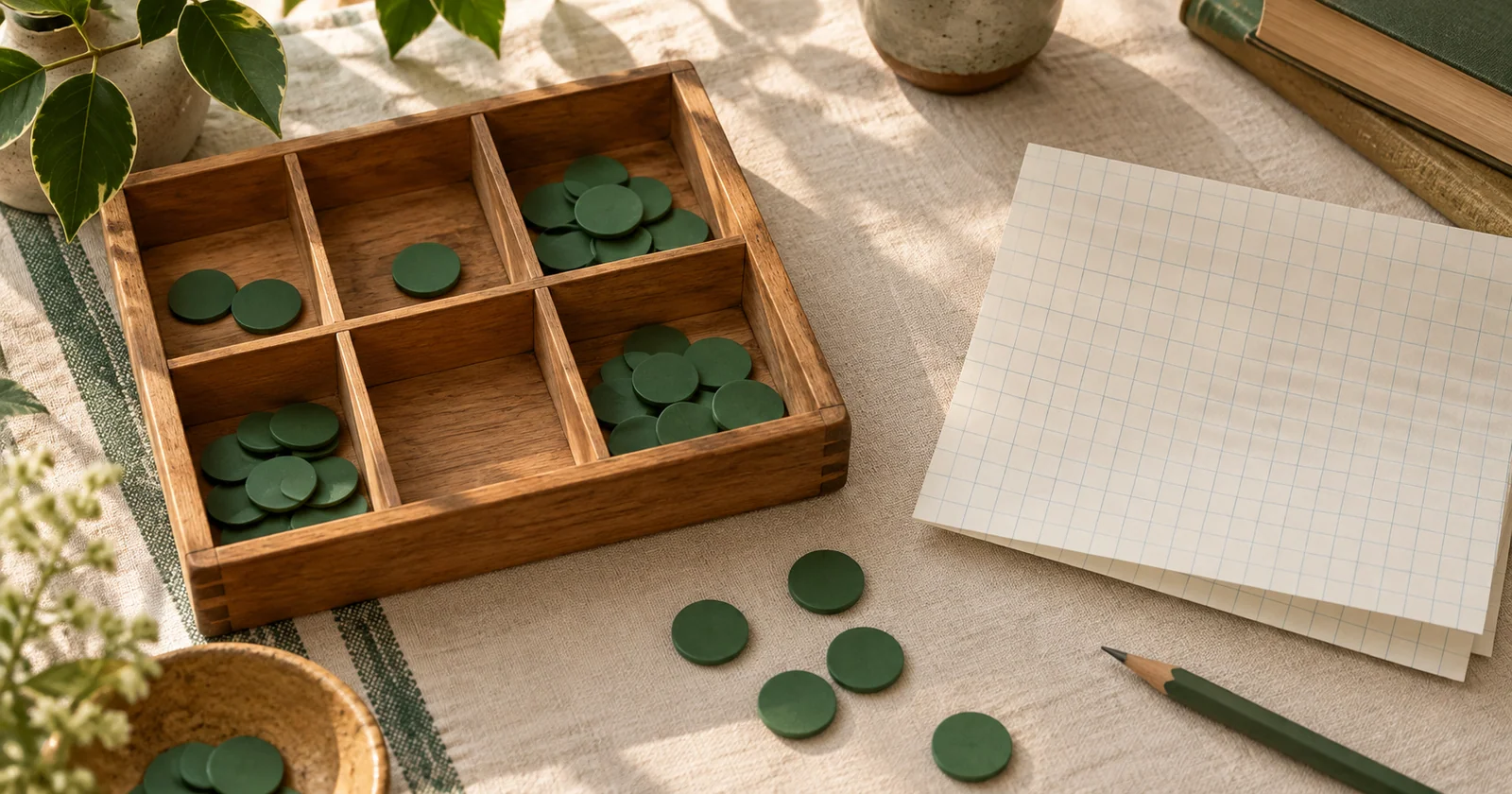
Separate the number of groups from the amount in each, model multiplication with counters, and use printable pictures to explain equal and unequal collections.
Read and draw multiplication arrays, connect rows and columns to two equations, and use original printable practice to explain missing dots and split products.
Compare equal groups, arrays, area models and partial products on shared examples, then use a printable diagnostic to choose the next useful multiplication step.
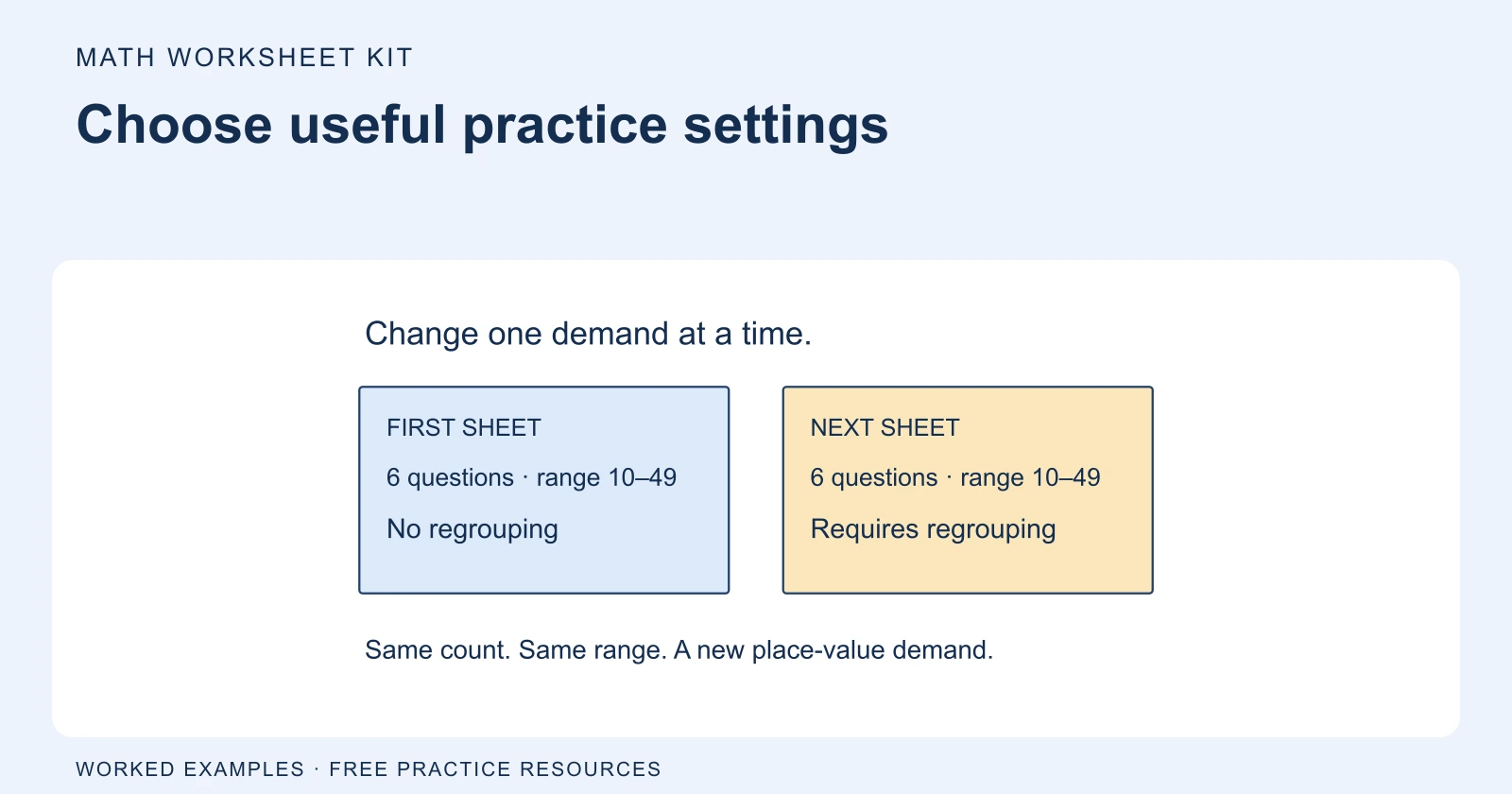
Choose the representation first: an array explains equal groups; a numerical sheet gives practice applying a strategy. The generator does not draw arrays, so pair a short sheet with a drawing when the model is the lesson.
Select a fixed table and set the range for the other factor. Start with six questions; sampled facts may repeat and do not form a complete ordered table.
Choose exact division with a small largest divisor. Rebuild each dividend using the related multiplication fact.
Work through one example
For 4 × 6, draw four rows of six. Doubling six gives twelve; doubling again gives twenty-four. Rotating the array gives 6 × 4 = 24, while the total stays the same.
Check the method
For larger factors, partition both numbers: 23 × 14 = 200 + 80 + 30 + 12 = 322. Keeping all four partial products prevents a missing-region error.
Know the limit: These are single-operation questions. A numerical answer key checks the result, while a drawing or explanation checks what the learner understood.
A little more context
Questions about multiplication
Which method should I start with?
Begin with equal groups and arrays when multiplication is new. Move to partitioning and written methods once the learner can explain what the factors represent.
Are answers included?
Practice resources include checked answers. The worksheet generator also offers separate questions and answer sheets.


 Rob