 Rob
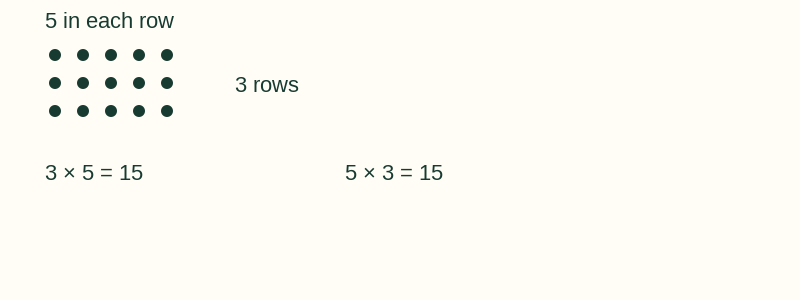
A multiplication array arranges objects in equal rows and equal columns. It makes a product visible: three rows containing five objects each show 3 × 5 = 15. Looking down the same arrangement reveals five columns containing three objects each, so it also shows 5 × 3 = 15. The objects have not changed; your description of their grouping has.
If the rows and columns are hard to interpret, begin with equal groups multiplication with pictures. Make separate groups first, then arrange the same objects into rows to compare the two representations.
Open the printable array practice and separate answer page. The sheet includes diagrams to label, arrays to draw and incomplete arrangements to explain. Use the browser’s Print command. Read the examples below first if rows and columns are unfamiliar.
Read the rows, columns and total
| Rows | In each row | Total |
|---|---|---|
| 3 | 5 | 15 |
| 5 | 3 | 15 |
| 4 | 6 | 24 |
Try the method
- Count the equal rows and the items in one complete row.
- Multiply those two counts.
- Rotate the array and name what changed.
- Check that no dot was added or lost.
Reading and building complete arrays
Read an array without counting every dot
Place a finger beside the top horizontal row and move across it. There are five dots in that row. Move down the left edge and count the horizontal rows: there are three. A useful spoken description is “three rows of five”. This names both the number of groups and the size of each group, rather than giving two unexplained numbers.
Write 5 + 5 + 5 = 15 underneath. Each addend represents one complete row. Now write 3 × 5 = 15 using the convention that the first factor tells how many groups there are. A learner who writes 5 × 3 has still written a true multiplication fact. Ask them to explain whether they were looking at columns before deciding that the model was misunderstood.
The aim is to use the equal structure. Someone can find fifteen by touching every dot once, but that does not yet show that they recognise multiplication. Ask, “If you know the top row has five, what do you know about the next row?” Equal rows let us use a known group size repeatedly without recounting each object.
Draw an array that another person can read
To draw 4 × 6, choose four rows of six counters. Sketch the first row with comfortable spaces between dots. Put each dot in the second row directly underneath a dot in the first. Repeat until there are four rows. Straight alignment makes columns visible; a scattered picture containing twenty-four dots does not communicate the same structure.
Check the finished arrangement in two directions. Every horizontal row must contain six dots, and every vertical column must contain four. Then label the side “4 rows” and the top “6 in each row”. These labels are particularly helpful when the drawing is rectangular but the dots are crowded or the learner forgets which number they started with.
A square array, such as 4 × 4, is useful later, but it hides the difference between row count and row size because both numbers are four. Begin with an unequal pair such as 2 × 7 or 3 × 5. After the meanings are clear, include square arrangements to show that arrays need not be wider than they are tall.
Find two equations in one picture
Consider four rows of six. Counting across each row produces 6 + 6 + 6 + 6 = 24. Counting down each column produces 4 + 4 + 4 + 4 + 4 + 4 = 24. The first view gives 4 × 6, and the second gives 6 × 4. Both describe every dot exactly once.
This is a concrete reason for the commutative property of multiplication: exchanging the two factors preserves the product. You can turn the paper a quarter-turn to see the old columns become the new rows. You can also leave the paper still and change your point of view. Rotation is a demonstration, not an additional calculation step.
Be precise about what stays equal. Four bags of six beads and six bags of four beads both contain twenty-four beads, but they involve different numbers of bags. An array shows equal totals without proving that the two real-world arrangements are interchangeable for every purpose. If the question asks how many bags are needed, the grouping still matters.
Use a familiar part to find an unfamiliar product
An array can connect a new fact to a known one. Draw six rows of seven dots and make a line after the fifth row. The top section contains five rows of seven, or thirty-five dots. The bottom section contains one more row of seven. Altogether, 6 × 7 = 35 + 7 = 42.
The line separates groups without adding or removing dots. This matters because a learner may accidentally include the boundary row in both sections. Point to the rows in the first section, then the remaining row, to check that each belongs to exactly one part. The two partial products must cover the complete original array.
You could instead split seven columns into five and two. Then 6 × 7 becomes 6 × 5 + 6 × 2, which is 30 + 12 = 42. Neither partition is compulsory. Choose one that uses facts the learner can explain confidently. Draw only one partition at a time initially, so the picture does not become a maze of lines.
Handle missing dots and incomplete rows
Suppose a picture is meant to show three rows of five, but the bottom row contains only four dots. There are fourteen visible dots, while the completed array would contain fifteen. Ask two separate questions: “How many dots are visible?” and “How many dots belong in the finished array?” These have different answers for a good reason.
One useful exercise shows a rectangular outline and only its top row and left column. A learner can infer the missing interior positions from the stated row and column counts. They should explain the complete structure before writing a product. Merely counting the dots already drawn would answer a different question.
An irregular arrangement is a deliberate non-example. Three rows containing four, five and four dots do not show three equal groups of one size. The total is thirteen, but 3 × 4 does not describe the whole collection. Rearranging counters might produce a different array if the total allows it; it cannot make unequal row lengths equal without changing their positions.
Use the printable in three passes
Begin with the completed pictures. For each one, say the grouping aloud, write the repeated addition and then write both multiplication equations. Keep the picture visible while explaining. This first pass checks whether the learner understands the relationship among objects, groups and symbols.
Next, work on the drawing questions. Have the learner plan the rows before drawing individual dots. A rough rectangle can help organise the space, but its edges do not count as rows. After drawing, let another person read the array without hearing the original instruction. If the intended factors are unclear, improve the alignment or add labels.
Finish with the incomplete and unequal-row questions. These demand more than recognising a familiar shape. Ask for a sentence that identifies exactly what is missing or unequal. The answer page explains the distinction between the visible count and the completed product so that a correct explanation is not rejected merely for using different wording.
Discuss the reasoning behind selected answers
Two rows of eight contain sixteen objects: 8 + 8 = 16, 2 × 8 = 16 and 8 × 2 = 16. The second multiplication equation reads the same picture as eight columns of two. It does not require drawing another sixteen dots beside the first array.
Five rows of three contain fifteen objects. The sentence “there are five in each row” would describe a different orientation from the one specified. The total alone cannot diagnose this confusion because 3 × 5 also equals fifteen. Ask the learner to point to one row when checking the explanation.
For four rows of seven, splitting each row after five dots gives twenty dots on the left and eight on the right. Thus 4 × 7 = 4 × 5 + 4 × 2 = 28. Adding the factors, 4 + 7, gives eleven and does not count all the objects. The partitioned drawing makes the missing repeated groups visible.
Move from drawings to multiplication facts
Try covering one complete row with a strip of paper. In a four-row array of six, the visible three rows contain eighteen, and the covered row contributes another six. Ask for the whole total before lifting the paper. This checks whether the learner can infer a hidden equal group from the array’s structure. Keep the covered section exactly one complete row so the missing amount is unambiguous.
Once the structure is secure, shorten the drawing. A labelled rectangle with a few example dots can stand for the full array if everyone understands the convention. Eventually the learner may picture the arrangement mentally and explain a product using its parts. Returning to a complete array remains useful whenever a fact or an explanation becomes uncertain.
For more numerical practice, use the multiplication worksheet generator. Draw an array beside selected questions rather than expecting the tool to produce array diagrams. Choose manageable factors when drawing every object; large products are better explored with an area model or partial products after equal groups are understood.
The rotation leads directly to Commutative property of multiplication with array examples, where the order changes but the product does not.