 Rob
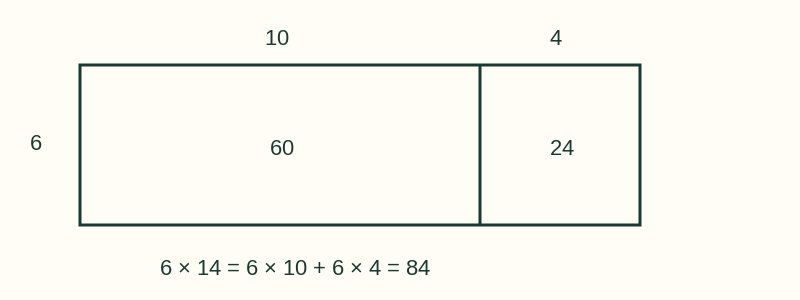
The distributive property lets us multiply a sum by multiplying each part and then adding the results. For example, 6 × 14 = 6 × (10 + 4) = 60 + 24 = 84. An area diagram makes the reason visible: a rectangle six units high and fourteen units wide can be split into a six-by-ten rectangle and a six-by-four rectangle.
Open the printable split-rectangle activity and worked key. The sheet asks for more than final products: label each width, calculate both partial areas and check that the parts reconstruct the original rectangle. Several questions allow more than one valid partition.
Partition every group once
| Product | Partition | Partial products | Total |
|---|---|---|---|
| 6 × 14 | 6 × (10 + 4) | 60 + 24 | 84 |
| 8 × 19 | 8 × (20 − 1) | 160 − 8 | 152 |
| 23 × 14 | (20 + 3) × (10 + 4) | 200 + 80 + 30 + 12 | 322 |
Try the method
- Choose parts whose sum or difference equals the original factor.
- Multiply every part by the other factor.
- Recombine using the same addition or subtraction.
- Check that the regions cover the original rectangle exactly once.
Read and partition the rectangle
Read the dimensions before calculating
In a rectangle model, the side labels describe lengths and the product describes area. A rectangle six units high and fourteen units wide has an area of eighty-four square units. Draw a vertical partition at ten units across. The left part has width ten, while the right part has the remaining width four.
The height is six on both sides of the partition. That unchanged dimension is the key to the distributive property. Calculate the left area as 6 × 10 = 60 and the right area as 6 × 4 = 24. Adding sixty and twenty-four gives the area of the complete rectangle because the two parts cover it without gaps or overlaps.
A diagram may be schematic rather than drawn to exact scale. Read the numerical labels when calculating, but draw widths in reasonably consistent proportions when practical. A width labelled ten should not look much narrower than a neighbouring width labelled four if the picture is intended to support size comparisons.
Split the same rectangle in another way
Fourteen can also be partitioned as seven plus seven. The same rectangle then becomes two six-by-seven parts. Each has area forty-two, so the complete area is 42 + 42 = 84. This second partition agrees with the ten-and-four split, even though the intermediate products are different.
A third choice is twelve plus two: 6 × 12 + 6 × 2 = 72 + 12 = 84. These are not three different original rectangles. They are three ways to divide the same width into parts. Preserve the full height and make sure the smaller widths sum to fourteen every time.
Choose a split based on helpful facts. Ten and four uses a multiplication by ten plus a smaller fact. Seven and seven is attractive if six sevens is known and doubling forty-two feels comfortable. Twelve and two may be useful for someone who already knows six twelves. The property allows a choice; it does not prescribe one favourite partition.
Connect every part of the equation to the picture
Write 6 × (10 + 4) = (6 × 10) + (6 × 4). The six outside the brackets applies to the entire combined width. On the right, it appears in both partial products because both subrectangles have height six. The plus sign combines their areas.
A common incorrect line is 6 × (10 + 4) = 60 + 4. That multiplies only the first width by six and leaves the second as a length. In the picture, the right section contains six rows of four square units, not just four square units. The missing factor is visible as five uncounted rows in that section.
Another error is to add the side lengths before calculating area: six plus fourteen is twenty. That sum does not count the unit squares inside the rectangle. If the task concerns area, the relevant operation is multiplication of perpendicular lengths. Keep the units attached: side lengths are units; area is square units.
Use place-value partitions for larger factors
For 7 × 23, split twenty-three into twenty and three. Seven twenties make one hundred and forty; seven threes make twenty-one. The full product is 140 + 21 = 161. The tens part is twenty, not two, so the first partial product is one hundred and forty rather than fourteen.
You can derive that first result from a known fact: seven times two is fourteen, so seven times two tens is fourteen tens, or one hundred and forty. Saying the unit “tens” prevents a place-value step from becoming an unexplained instruction to append a zero.
For 8 × 36, use thirty and six. Eight thirties equal two hundred and forty, while eight sixes equal forty-eight. Together they make two hundred and eighty-eight. Estimate beforehand: eight times thirty is two hundred and forty and eight times forty is three hundred and twenty, so the exact answer should lie between those values.
Partition the other dimension too
The rectangle for 12 × 15 can be split horizontally into heights ten and two while keeping width fifteen. The two partial areas are 10 × 15 = 150 and 2 × 15 = 30. The total is one hundred and eighty. This is the same distributive idea applied to the other factor.
You can also split fifteen into ten and five, giving 12 × 10 + 12 × 5 = 120 + 60 = 180. Comparing the two drawings shows that either factor can be partitioned. The factor that is not split remains present in every partial product.
Splitting both dimensions creates four rectangles. For twelve split into ten and two, and fifteen split into ten and five, the areas are one hundred, fifty, twenty and ten. Their sum is one hundred and eighty. This prepares for a fuller area model, but keep one-dimensional splits clear before adding a second partition line.
Use a nearby larger number and remove the excess
Distribution also works with subtraction. For 9 × 19, think of nineteen as twenty minus one. Nine twenties make one hundred and eighty, and nine ones make nine. Subtract the excess strip: 180 − 9 = 171. The removed strip has height nine and width one.
The subtraction must remove a complete strip, not merely one square unit. Writing 9 × 19 = 9 × 20 − 1 would give one hundred and seventy-nine, which is too large. The extra one in each of nine rows contributes nine altogether. Label the strip before deciding what to subtract.
For 6 × 48, using fifty minus two gives 300 − 12 = 288. A tens-and-ones split gives 240 + 48 = 288. These independent decompositions provide a useful agreement check. Choose the route whose intermediate facts are simpler for the learner, while keeping the reason for the adjustment explicit.
Check that a partition is valid
Keep a chain of equations balanced at each stage. The line 6 × 14 = 60 + 24 = 84 is valid because every expression has the same value. Writing 6 × 14 = 60 = 84 would incorrectly equate the full rectangle with only its left section. Partial areas belong inside the complete sum until they have been combined.
A correct partition must satisfy two conditions. Its side parts must reconstruct the original side, and its smaller regions must cover the original rectangle exactly once. For a width of seventeen, ten plus seven is valid, as is eight plus nine. Ten plus eight would describe width eighteen and therefore a different rectangle.
Check the arithmetic separately from the partition. A learner can choose the correct split but calculate one partial product incorrectly. For 4 × 17, the split 4 × 10 + 4 × 7 is valid; the values are forty and twenty-eight, giving sixty-eight. An answer of sixty-four would require checking the small multiplication or the final addition.
Use an inverse check when suitable: sixty-eight divided into four equal rows gives seventeen per row. Another check is repeated addition, 17 + 17 + 17 + 17 = 68. Repeating the same incorrect partial-product calculation is less informative than verifying through a different route.
Make the printable an explanation task
Begin with the labelled rectangle for 5 × 16. Fill the parts as five times ten and five times six, giving fifty and thirty, then combine them to get eighty. Ask why the five appears twice. The answer should refer to the shared height of both parts, not merely to a rule about copying numbers.
Next, use the blank rectangle for 7 × 18. A learner might choose ten and eight, giving seventy plus fifty-six, or twenty minus two, giving one hundred and forty minus fourteen. Both routes produce one hundred and twenty-six. The subtraction version needs an extended rectangle and a removed strip, so its drawing should show that extra construction.
The same-product challenge asks for two partitions of 6 × 15. Ten and five gives sixty plus thirty. Eight and seven gives forty-eight plus forty-two. Each equals ninety. Comparing these intermediate values helps show that partial products can change while the original product remains fixed.
Finally, repair the claim 3 × (20 + 4) = 60 + 4. The correct right section is three times four, or twelve, so the total is seventy-two. Have the learner shade the region that the incorrect answer missed. A visual correction makes the numerical explanation more precise.
Move towards compact multiplication
Splitting a factor into a sum is different from choosing which of three factors to multiply first. Compare it with regrouping factors with the associative property.
A missing-dimension problem can test the model in reverse. Suppose a rectangle has height four and total area ninety-two. One part has width twenty and area eighty. The remaining area is twelve, so its width is three because four times three is twelve. The complete width is twenty-three. This connects the partial areas back to the side lengths rather than treating the diagram as decoration around a calculation.
Another reverse question gives two partial products, fifty-six and twenty-one, both made with a factor of seven. Their other factors are eight and three. Combining the widths gives eleven, so the full product is seven times eleven, or seventy-seven. A learner who adds seven twice as part of the width has mixed the shared height with the partitioned dimension. Point back to the two perpendicular directions and keep their labels separate. Reverse questions are most useful after forward examples feel secure, because they require both multiplication facts and interpretation of the diagram.
Once the diagrams are familiar, a labelled rectangle without individual unit squares can carry the same reasoning. Later, the expanded equation alone may be enough. Keep the option of drawing available when a partial product loses its place value or a factor is accidentally omitted.
Use the multiplication worksheet generator for further numerical products and add your own partitions beside selected questions. The original printable here supplies the area diagrams; the generator’s ordinary questions should not be described as an automatic area-model feature.
When both dimensions are partitioned, Area model multiplication: worked examples and practice shows why every smaller region contributes.