See the groups, patterns and place value behind multiplication.
A practical starting point
Move from equal groups and arrays to multi-digit methods. Lessons connect a picture, an equation and a worked solution so practice has a clear purpose.
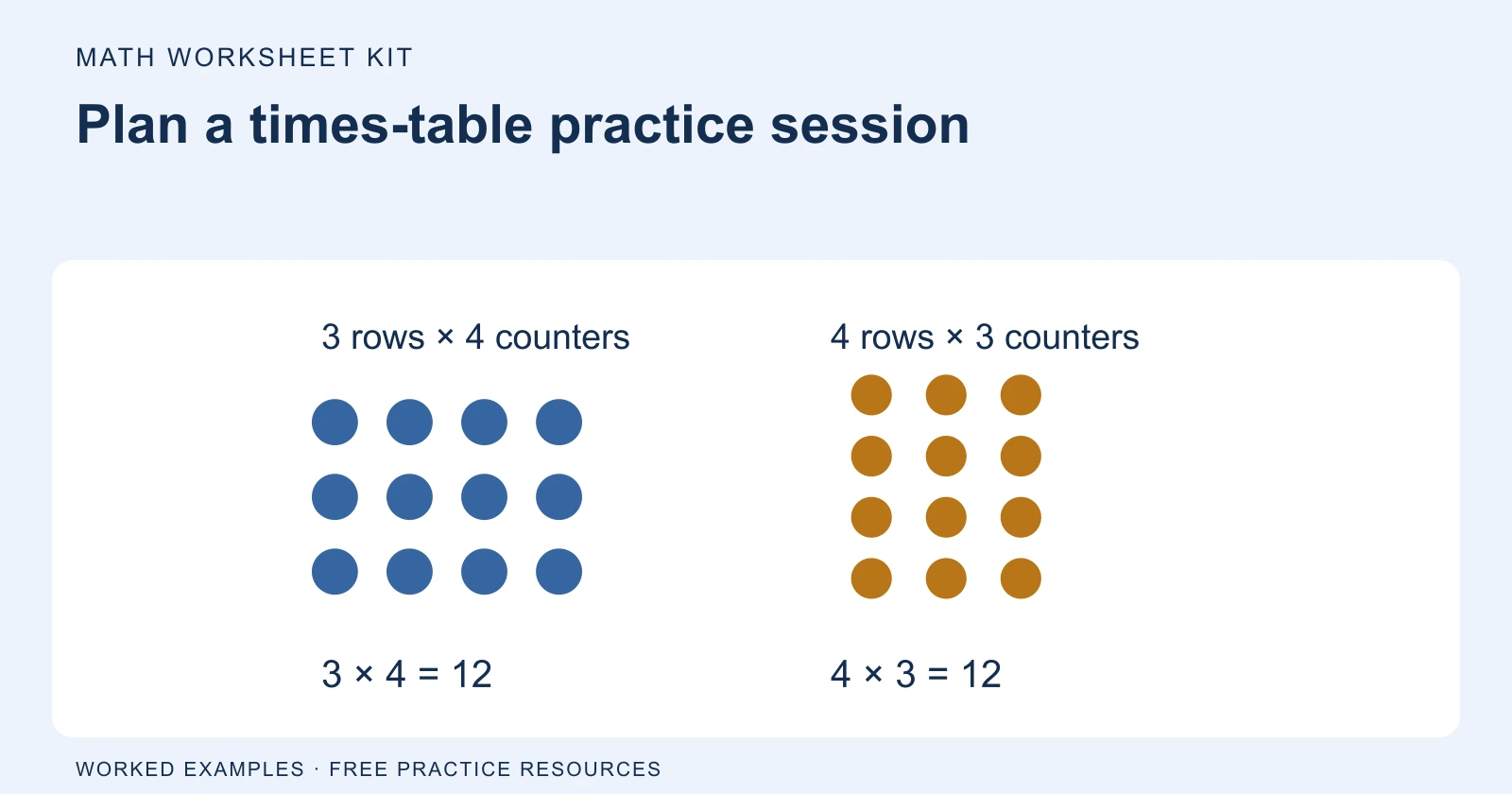
Choose the representation first: an array explains equal groups; a numerical sheet gives practice applying a strategy. The generator does not draw arrays, so pair a short sheet with a drawing when the model is the lesson.
Select a fixed table and set the range for the other factor. Start with six questions; sampled facts may repeat and do not form a complete ordered table.
Choose exact division with a small largest divisor. Rebuild each dividend using the related multiplication fact.
Work through one example
For 4 × 6, draw four rows of six. Doubling six gives twelve; doubling again gives twenty-four. Rotating the array gives 6 × 4 = 24, while the total stays the same.
Check the method
For larger factors, partition both numbers: 23 × 14 = 200 + 80 + 30 + 12 = 322. Keeping all four partial products prevents a missing-region error.
Know the limit: These are single-operation questions. A numerical answer key checks the result, while a drawing or explanation checks what the learner understood.
A little more context
Questions about multiplication
Which method should I start with?
Begin with equal groups and arrays when multiplication is new. Move to partitioning and written methods once the learner can explain what the factors represent.
Are answers included?
Practice resources include checked answers. The worksheet generator also offers separate questions and answer sheets.

 Rob