 Rob
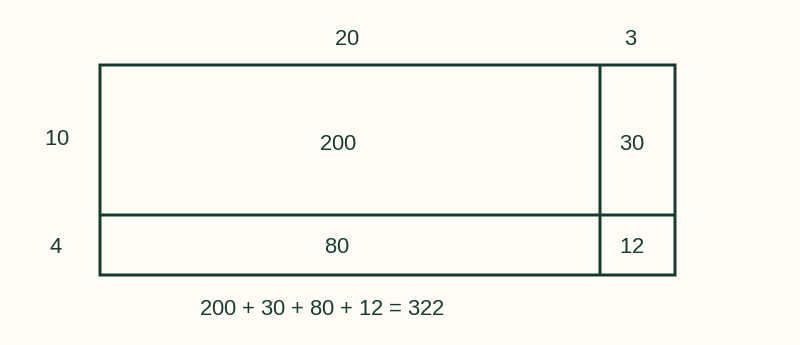
An area model multiplies larger numbers by splitting them into place-value parts and finding the area of each smaller rectangle. To calculate 23 × 14, split twenty-three into twenty and three, and fourteen into ten and four. The four partial products are 200, 80, 30 and 12. Together they give 322.
Open the printable area-model grids and worked answer page. Start with the prelabelled grid, then complete partly labelled grids and draw your own partitions. Every printed question has a matching worked answer showing all required partial products, so you can check the method as well as the total.
Account for every nonzero region
| Product | Parts | Partial products | Total |
|---|---|---|---|
| 23 × 14 | (20 + 3)(10 + 4) | 200 + 80 + 30 + 12 | 322 |
| 40 × 26 | 40(20 + 6) | 800 + 240 | 1040 |
| 124 × 13 | (100 + 20 + 4)(10 + 3) | 1000 + 300 + 200 + 60 + 40 + 12 | 1612 |
Try the method
- Partition each dimension and label its actual values.
- Pair each row part with every column part.
- Write each region's product in its cell.
- Add all regions; the number of regions depends on the partitions.
Understand what the grid represents
The large rectangle has a width of twenty-three units and a height of fourteen units. Its area is therefore twenty-three times fourteen square units. A vertical partition divides the width into twenty and three. A horizontal partition divides the height into ten and four. Their intersection creates four smaller rectangles.
The top-left rectangle combines width twenty and height ten, so its area is two hundred. The top-right rectangle combines width three and height ten, so its area is thirty. The lower-left rectangle combines twenty and four, giving eighty. The lower-right combines three and four, giving twelve.
The side labels are lengths; the values inside the cells are areas. Writing “20” inside the top-left cell just because its column is labelled twenty would confuse the dimension with the product. Ask which two perpendicular labels belong to each cell before calculating it.
The diagram need not contain three hundred and twenty-two tiny squares. Once multiplication as area is understood, a labelled partitioned rectangle represents them compactly. State when a grid is schematic. An equal-sized four-cell table is a calculation organiser, while a proportioned rectangle also communicates the relative sizes of the partial areas.
Work through different partitions
Work through twenty-three times fourteen
First estimate. Twenty-three is between twenty and thirty, and fourteen is between ten and twenty. A rough central estimate is twenty times fifteen, or three hundred. This does not establish the exact answer, but it makes a result around three hundred plausible and a result around thirty suspicious.
Next expand the factors: 23 = 20 + 3 and 14 = 10 + 4. Write the parts outside the grid before filling any cells. Check that the two column widths sum to twenty-three and the two row heights sum to fourteen. An incorrect partition changes the entire problem even if later multiplication is flawless.
Now calculate every crossing. Ten times twenty is two hundred; ten times three is thirty; four times twenty is eighty; four times three is twelve. Mark each cell as it is calculated so no region is omitted. Each factor part must meet every part of the other factor.
Finally add the partial areas. One convenient grouping is 200 + 80 = 280 and 30 + 12 = 42, followed by 280 + 42 = 322. Another is 200 + 30 = 230 and 80 + 12 = 92, followed by 230 + 92 = 322. These correspond to combining columns or rows of the diagram.
Explain why four products are needed
A frequent error is to multiply only the tens parts together and the ones parts together. For 23 × 14, that would give 200 + 12 = 212. The missing regions are twenty times four and three times ten. Their areas, eighty and thirty, total one hundred and ten, exactly the amount missing from the correct answer.
Shade the two counted cells and leave the other two blank. The drawing shows immediately that the partial calculation has not covered the whole rectangle. There is no mathematical reason to ignore the top-right and lower-left corners; they are part of the original region just as surely as the diagonal cells.
Another way to explain this is through equal groups. Fourteen groups of twenty-three contain fourteen groups of twenty and fourteen groups of three. Splitting fourteen into ten and four then divides each of those collections again. Both parts of twenty-three still occur in both groups of rows.
Use a product that crosses a hundred
Consider 36 × 27. Split thirty-six into thirty and six, and twenty-seven into twenty and seven. The four cells are 30 × 20 = 600, 6 × 20 = 120, 30 × 7 = 210 and 6 × 7 = 42. Add six hundred and one hundred and twenty to get seven hundred and twenty; add two hundred and ten and forty-two to get two hundred and fifty-two.
The two row totals give 720 + 252 = 972. This final addition keeps the places aligned: two tens plus five tens gives seven tens, while the hundreds total nine and the ones total two. If adding all four numbers at once feels crowded, use the visible rows to organise two intermediate totals.
Check through a different decomposition: twenty-seven is thirty minus three, so thirty-six times twenty-seven is 1,080 minus 108, or 972. This check does not reuse the same four grid products. It offers an independent route that can reveal an incorrect cell or addition.
Estimate as well: thirty-six times twenty-five is nine hundred, and two additional thirty-sixes contribute seventy-two. The exact result nine hundred and seventy-two sits sensibly above nine hundred. An estimate is a reasonableness check; only an exact calculation establishes the final units.
Handle a zero ones digit without inventing a region
For 40 × 26, forty has no ones part. You can use one column labelled forty and two rows labelled twenty and six. The areas are 40 × 20 = 800 and 40 × 6 = 240, giving 1,040. There is no need to draw a positive-width ones column for zero.
If a standard four-cell organiser is used, a zero column may be shown as a symbolic placeholder, with both products zero. Explain that this is a table convention, not a literal rectangle with a visible positive width. Otherwise the model may suggest that zero contributes an area merely because a box has been drawn for it.
The product forty times six is two hundred and forty because four tens multiplied by six makes twenty-four tens. The zero in forty records its place value. It is not an instruction that replaces understanding of the units being multiplied.
Extend the model to another place-value part
For 124 × 13, split the first factor into one hundred, twenty and four, and the second into ten and three. A three-column, two-row grid has six partial products. The top row contains three separate values: 1,000, 200 and 40. The bottom row contains 300, 60 and 12.
Sum the top row as 1,240 and the bottom row as 372. Their combined total is 1,612. The principle is unchanged: each part of one factor multiplies every part of the other. More place-value parts create more intersections, but no new arithmetic rule is needed.
A learner could instead partition the first factor into just two parts: one hundred and twenty, plus four. That creates four cells when combined with the two parts of thirteen, with more demanding partial products. Both partitions are valid. Standard hundreds, tens and ones often keep the small facts easier to manage.
Recognise valid nonstandard partitions
Place-value partitioning is convenient, not compulsory. For 25 × 16, split sixteen into eight and eight while leaving twenty-five intact. Each partial product is two hundred, so the total is four hundred. This uses doubling and a familiar twenty-five-times-eight fact.
You can also split twenty-five into twenty and five, and sixteen into ten and six. The areas are two hundred, fifty, one hundred and twenty, and thirty, again totalling four hundred. Comparing the two models shows that the rectangle’s total area does not depend on the particular internal partitions.
When offering a free-choice split, require labels and a reconstruction check. A learner might choose twelve plus four for sixteen or fifteen plus ten for twenty-five. These are valid if the resulting partial products are correct. The goal is a transparent calculation, not compliance with one specific arrangement of grid lines.
Diagnose mistakes by their location
If a side is labelled two and three for the number twenty-three, the problem begins in the expansion. Replace the two with twenty before recalculating. Calling it “two tens” is also valid if the grid clearly preserves that unit throughout the products.
If the dimensions are correct but 20 × 10 is written as twenty, the issue lies inside one cell. Read the units: twenty multiplied by ten means ten twenties, giving two hundred. Point to the whole cell to avoid treating the ten as an ornamental label.
If all four cells are correct but the total is wrong, leave the model intact and examine the addition. Recombine by rows instead of columns, or align the partial products by place value. Rebuilding a correct grid from scratch may hide the specific skill that needs attention.
If the result is ten times too small or too large, examine tens and hundreds in the partial products before looking for a one-unit arithmetic slip. Estimate the product’s size and compare it with the two factors. For positive factors greater than one, a product smaller than either factor cannot be correct.
Use the printable progression
The first question, 12 × 13, has all side labels supplied. Its partial areas are one hundred, twenty, thirty and six, giving one hundred and fifty-six. Read across and down to connect each cell with its two labels before moving to a grid where some labels are missing.
The second question asks for 24 × 15. Its cells are two hundred, forty, one hundred and twenty, totalling three hundred and sixty. The next examples include 32 × 14 and 36 × 27 so that the addition cannot always be completed by merely placing nonoverlapping digits beside one another.
The zero-part question, 40 × 26, permits a two-cell diagram. The extension, 124 × 13, needs six cells when standard place-value parts are used. The final error-analysis item omits the two crossing products from 23 × 14; repair both the picture and the numerical answer.
Use only as much of the sheet as the learner can explain carefully. A completed grid with no account of why the products belong in their cells is less informative than a smaller number of labelled examples. The answer page supports discussion of alternative valid splits as well as checking the printed route.
Connect the model to partial products
Before setting aside the picture, try a missing-label check. In the grid for twenty-three times fourteen, cover the width label three but leave the upper-right area thirty and row height ten visible. The missing width must be three because ten times three equals thirty. Confirm it using the lower-right cell: four times three equals twelve. Two independent cells now agree on the same dimension. This reverse reading shows whether the learner sees a relationship between lengths and areas, rather than a routine for filling boxes from left to right.
After the grid is secure, write its partial products in a vertical list. For 23 × 14, the entries are two hundred, thirty, eighty and twelve. Adding them by place value gives the same three hundred and twenty-two. The list is a compact record of the rectangles, so the geometry remains available as an explanation when needed.
The multiplication worksheet generator supplies additional numerical products. Sketch a grid beside selected questions if you want area-model practice. Use the printable linked here for ready-drawn grids; ordinary numerical generation does not automatically produce this diagram layout.
Keep the same products when moving from the drawing to Partial products multiplication without losing place value.