 Rob

The associative property of multiplication lets us change which factors we multiply together first without changing the product. For example, (3 × 4) × 5 = 3 × (4 × 5). The left side makes twelve first and then multiplies by five; the right side makes twenty first and then multiplies by three. Both give sixty.
Open the printable regrouping practice and worked answer page. The questions ask for two calculation routes, a choice of efficient grouping and explanations of incorrect bracket changes. They use whole-number factors so the focus stays on grouping.
Swap or regroup?
| Change | Example | What stays fixed |
|---|---|---|
| Regroup | (3 × 4) × 5 = 3 × (4 × 5) | Factor order |
| Swap | 3 × 4 × 5 = 4 × 3 × 5 | Factor values |
| Count a factor twice | 3 × 5 × 2 ≠ 6 × 10 | This is not a valid regrouping |
Try the method
- List each original factor once.
- Choose the pair that gives an easy intermediate product.
- Multiply by the remaining factor.
- Check that no factor was duplicated, lost or added.
Read and choose bracket groups
Give the three factors a meaning
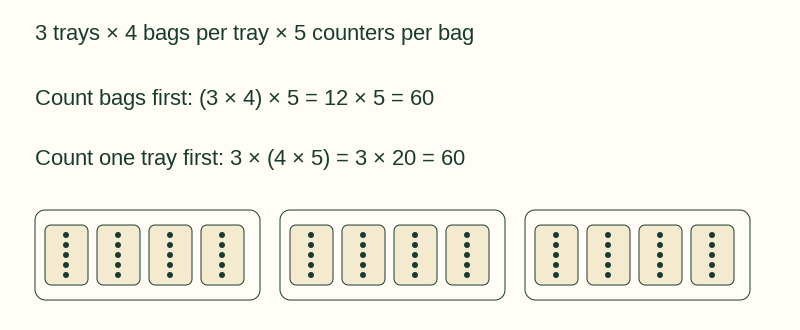
Imagine three trays. Each tray holds four small bags, and each bag contains five counters. There are three trays, four bags per tray and five counters per bag. The total can be expressed as 3 × 4 × 5. Before choosing a calculation order, establish what each factor measures.
One route counts all the bags first. Three trays times four bags per tray gives twelve bags. Twelve bags times five counters per bag gives sixty counters. Written with brackets, the route is (3 × 4) × 5 = 12 × 5 = 60. The brackets identify the intermediate amount: total bags.
The other route counts the contents of one tray first. Four bags times five counters per bag gives twenty counters per tray. Three trays containing twenty each give sixty counters. This is 3 × (4 × 5) = 3 × 20 = 60. The intermediate amount is different, but the final count includes the same counters exactly once.
Read brackets as a grouping instruction
Brackets show which expression belongs together. In (2 × 6) × 7, calculate two times six first, giving twelve, then multiply by seven to get eighty-four. In 2 × (6 × 7), calculate six times seven first, giving forty-two, then double it to get eighty-four.
The numbers remain in the same left-to-right order: two, six, seven. Only the grouping changes. That is what makes this an example of associativity. If you rewrite it as 2 × 7 × 6, you have also changed the order, which uses the commutative property. Both moves can be valid, but they are different moves.
Read the entire expression before working. A learner sometimes calculates the bracket correctly but forgets the factor outside it. For 4 × (3 × 5), fifteen is an intermediate result, not the final answer. The remaining factor four tells us to take four copies of fifteen, producing sixty.
Choose a grouping that creates an easy product
Consider 8 × 5 × 2. Multiplying eight and five first gives forty, then multiplying by two gives eighty. Multiplying five and two first gives ten, then multiplying eight by ten also gives eighty. The second route creates a ten, which may be easier to handle mentally.
For 7 × 4 × 25, grouping four and twenty-five gives one hundred. The calculation becomes 7 × 100 = 700. Starting with seven times four gives twenty-eight, followed by twenty-eight times twenty-five. That route is correct but may demand more work. The useful choice comes from noticing a familiar factor pair before calculating.
Similarly, 6 × 2 × 50 can become 6 × 100 = 600. The factors two and fifty are already beside one another, so only regrouping is required. Look for pairs that make ten, one hundred or another fact you know securely, rather than assuming that the leftmost multiplication must always be the quickest.
Compare two routes without forcing one winner
For 3 × 6 × 4, one route is eighteen times four, which gives seventy-two. Another is three times twenty-four, also seventy-two. Neither intermediate result is a round hundred or ten. Someone confident with doubling may prefer eighteen times four, while someone who knows three times twenty-four may prefer the other route.
Ask the learner to show both routes, then explain which felt easier. Their answer should name the useful fact or step: “I doubled eighteen twice” is more informative than “that way is better”. The purpose is to make a deliberate choice, not to invent a universal rule that one bracket position is always efficient.
A written comparison also gives a check. If one route gives seventy-two and the other gives seventy-six, the associative property tells us there is a calculation mistake somewhere. Inspect the intermediate products separately. The property does not identify the error by itself, but it establishes that the two valid routes should agree.
Separate regrouping from reordering when needed
The expression 5 × 13 × 2 invites us to combine five and two. Those factors are not adjacent in the written order. First use commutativity to write 5 × 2 × 13. Then use associativity to group (5 × 2) × 13. The result is 10 × 13 = 130.
You may make these changes mentally in one movement, but showing them separately is useful when learning the property names. Reordering brings a helpful pair together; regrouping chooses that pair as the first product. Both steps preserve the complete set of factors.
Check that no factor has been duplicated or dropped. Changing 5 × 13 × 2 into 10 × 26 would use the factor two twice: once to double five and again to double thirteen. Its value would be two hundred and sixty, not one hundred and thirty. Pairing factors means replacing that pair with its product once.
Do not transfer the rule to mixed operations
The associative property here concerns multiplication of all the factors. It does not say that arbitrary brackets can move across addition. The expression (2 + 3) × 4 equals twenty, while 2 + (3 × 4) equals fourteen. Moving those brackets changes which operation is applied to two, so the values differ.
Division also needs care. The expression (24 ÷ 6) ÷ 2 equals two, because four divided by two is two. But 24 ÷ (6 ÷ 2) equals eight, because twenty-four divided by three is eight. These are not equal. The visual similarity of three numbers and two operation signs does not make the multiplication rule applicable.
In an expression made only of multiplication, moving brackets between the factors is valid. In an expression involving other operations, evaluate according to the written grouping and established operation conventions. Use a numerical counterexample to test an overgeneralised rule rather than memorising “brackets do not matter”.
Include factors of zero and one
An equality chain must preserve value at every equals sign. Writing 2 × 3 × 8 = 6 = 48 is incorrect because six is only the first intermediate product. Write 2 × 3 × 8 = 6 × 8 = 48 so the remaining factor stays present until it has been used.
For (4 × 0) × 9, the first product is zero and the final product remains zero. For 4 × (0 × 9), the bracket also gives zero and the final product is zero. Associativity still holds. In a grouping story, zero objects in each smallest group means there are no objects to count overall.
A factor of one leaves a product unchanged: (7 × 1) × 6 = 7 × (1 × 6) = 42. This does not mean one can be replaced by zero. One group containing six contributes six; zero groups contribute nothing. Keep the meanings distinct even when simplifying a longer expression mentally.
Work through the printable in stages
The opening examples ask you to calculate both bracket positions. For 2 × 3 × 8, the routes are 6 × 8 and 2 × 24, each giving forty-eight. Writing intermediate results makes it possible to check whether an error comes from the first multiplication or the remaining one.
The choice questions include 9 × 4 × 25. A helpful grouping is 9 × (4 × 25), giving nine hundred. Another question uses 5 × 11 × 2 and asks you to explain the additional reorder: bring five and two together, form ten, then multiply by eleven to get one hundred and ten.
In the error-analysis question, the expression 3 × 5 × 2 has been changed to 6 × 10. The original factors three and five have each been multiplied by two, so the factor two has been counted twice. The correct product is thirty. Ask the learner to repair the route and explain the exact duplication, rather than only crossing out the wrong result.
Use the idea when products become larger
Regrouping changes which factors you multiply first. If you need to split a factor into easier parts instead, use the distributive property to split a product.
Make a brief record of the chosen grouping rather than writing only the final answer. For 4 × 5 × 6, recording 4 × 30 = 120 shows one route, while recording 20 × 6 = 120 shows another. If the learner changes their mind halfway through, cross out the abandoned intermediate expression and start from the original three factors. Mixing intermediate values from two different routes can accidentally count part of the product twice. A clear chain of equal expressions makes each replacement traceable and keeps the reasoning easy to check later.
Regrouping is especially useful when a known pair creates a simple intermediate value. It also helps explain why different correct calculation routes agree. Keep bracket notation visible until the learner can name what was combined and what remains to be multiplied.
The multiplication worksheet generator offers two-factor numerical practice. The printable supplied with this article provides the three-factor expressions for associativity. Use ordinary multiplication facts to strengthen uncertain intermediate steps, then return to choosing and explaining a complete route.
If the method changes factor order as well as brackets, explain the swap using Commutative property of multiplication with array examples.