Sharing, grouping and written methods, one clear step at a time.
A practical starting point
Explore division through groups, number lines and worked written methods. Each approach connects the quotient to multiplication and makes any remainder explicit.
Separate the meaning of division from the written layout. Sharing into equal groups, finding how many groups fit and carrying out long division can use the same numbers but ask the learner to explain different things.
Use six questions for more working space. Start with exact answers, then introduce remainders without also increasing the dividend size.
Work through one example
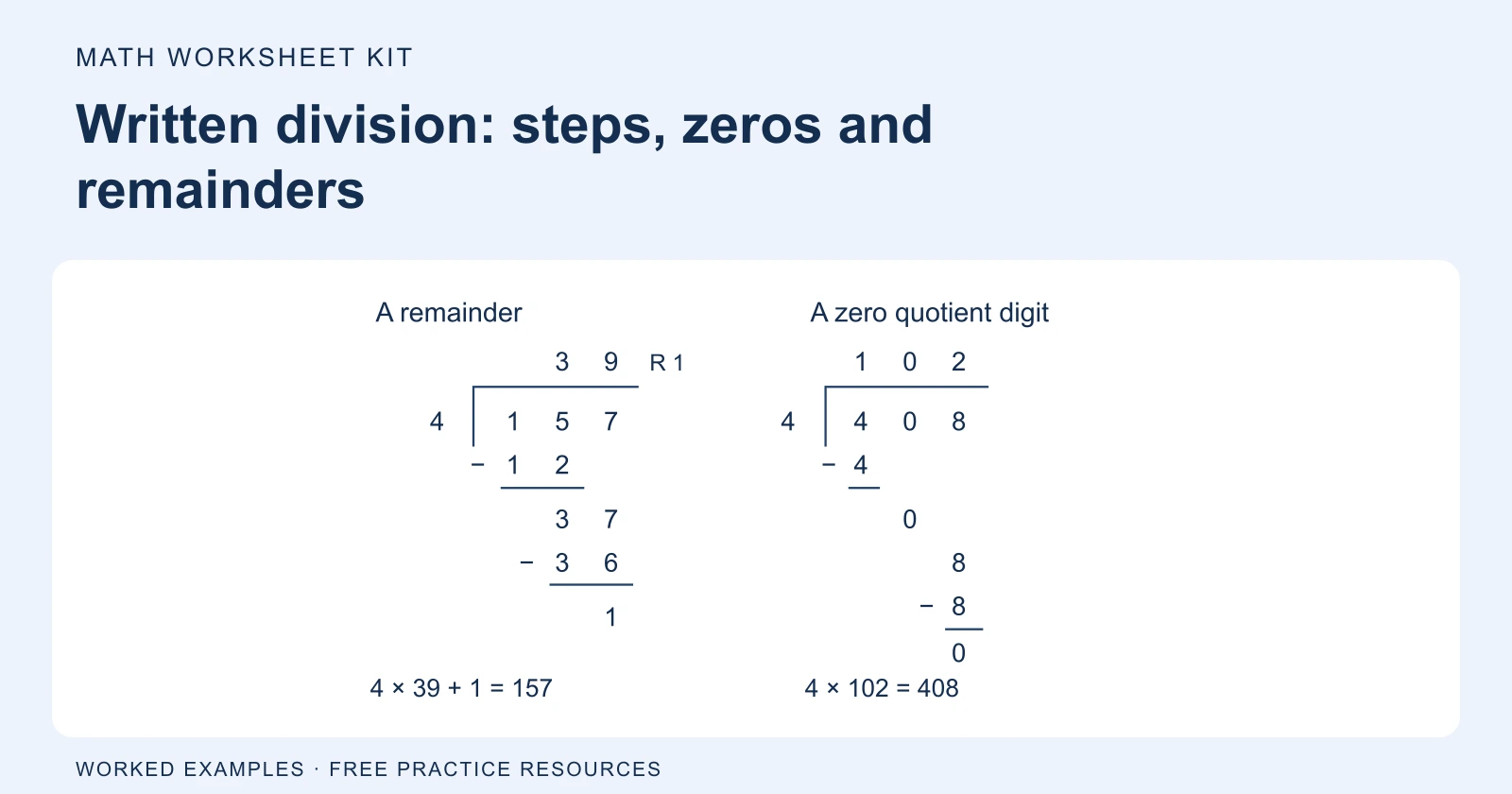
For 157 ÷ 4, divide 15 tens by four to get three tens, leaving three tens. With the seven ones, that makes 37 ones: nine groups of four leave one. The answer is 39 R 1.
Check the method
Check both conditions: 4 × 39 + 1 = 157 and the remainder 1 is smaller than 4. For 408 ÷ 4 = 102, the zero in the tens position must stay in the quotient.
Know the limit: Keys give final whole-number quotients and R notation, not every written step. Decimal division, interpretation of word problems and division by zero are not modes of these generators.
A little more context
Questions about division
How can I check a division answer?
Multiply divisor by quotient and add the remainder. The result should equal the dividend, and a whole-number remainder must be smaller than the divisor.
Should every answer be a whole number?
No. A remainder, fraction or decimal can each be useful. The context and requested answer format matter.

 Rob