 Rob

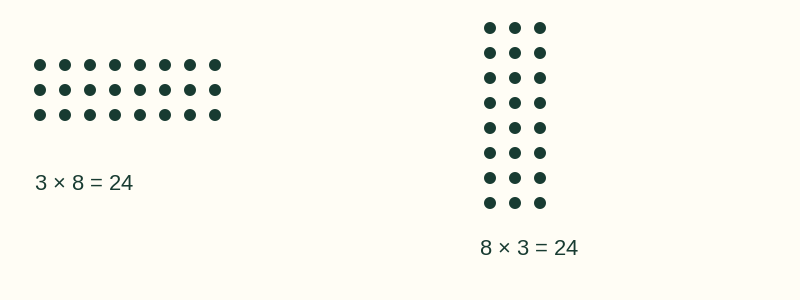
The commutative property of multiplication says that exchanging the two factors leaves the product unchanged. For example, 3 × 8 = 8 × 3 = 24. An array explains why: three rows of eight contain exactly the same objects as eight columns of three. We change the way we group or read the objects, while preserving the total.
Open the printable rotation activity and checked answer page. Draw or cut out the rectangular arrays, turn them a quarter-turn, and record the two multiplication facts. The final questions compare multiplication with division so the property is not applied to every operation.
Which operation allows a swap?
| Statement | Verdict | Reason |
|---|---|---|
| 3 × 8 = 8 × 3 | True | Both count 24 |
| 12 ÷ 3 = 3 ÷ 12 | False | 4 differs from 1/4 |
| (2 × 3) × 4 = 2 × (3 × 4) | True | This regroups; it does not swap |
Try the method
- Draw equal rows for one factor order.
- Rotate the complete array.
- Read the new rows and row size.
- Keep the story units attached even though the numerical product is unchanged.
Explain the rotated array
Rotate one array and describe both views
Draw two rows with seven dots in each. Count the rows and say “two rows of seven”. The product is fourteen. Turn the page through a quarter-turn, then count the new rows. There are now seven rows with two dots in each, still fourteen dots altogether.
Record 2 × 7 = 14 and 7 × 2 = 14. The equals signs make claims about equal values. They do not mean “do something next”. A combined statement, 2 × 7 = 7 × 2, says that both expressions have the same value even before we write the value fourteen.
Use a rectangle with unequal side counts first. Rotating a 5 × 5 square also preserves its product, but both factors are five, so the exchange is less visible. A long narrow array makes the difference between orientations clear while keeping the number of dots manageable.
Explain the property beyond a single example
In a rectangular array, each dot occupies one row and one column. Counting complete rows includes every dot once. Counting complete columns also includes every dot once. Therefore the two counts must agree. This is the structural reason the property holds for whole-number products represented by arrays.
Checking 3 × 8 and 8 × 3 with a calculator confirms that example, but the array reasoning explains the relationship. The explanation works for any whole-number rectangle of dots, not just the particular facts already memorised. You can choose a new row count and column count and use the same counting argument.
The factors exchange roles; they are not replaced by unrelated numbers. From 4 × 9 = 36, commutativity gives 9 × 4 = 36. It does not by itself justify 6 × 6 = 36, although that equation is also true. Six and six describe a different factor pair, requiring another calculation or model.
Use a known fact in the other order
If a learner knows that five groups of six make thirty, they can use that knowledge for six groups of five. The products agree by commutativity. Draw a 5-by-6 array and read it both ways if the connection is uncertain. The second fact becomes connected knowledge rather than another isolated answer to remember.
This can simplify a calculation mentally. For 9 × 2, someone may prefer to think of two nines and double nine to get eighteen. The original expression can still mean nine groups of two in a story. Exchanging the factors is a calculation strategy, while the wording of the original situation continues to determine what the quantities represent.
Ask “Which order is easier for you to calculate, and why?” rather than prescribing one order for every fact. A person comfortable with counting by fours may use 7 × 4 directly. Another may know four sevens through doubling. Both choices are valid if the explanation preserves the same two factors and product.
Keep units and context attached
Three boxes holding eight pencils each contain twenty-four pencils. Eight boxes holding three pencils each also contain twenty-four pencils. These situations share a product, but they require different numbers of boxes. If you are packing pencils into boxes of eight, the answer to “how many boxes?” is three, not eight.
Draw the separate boxes as well as the array when that distinction is confusing. The commutative property concerns the numerical product. It does not claim that buying three packs at eight pounds each is the same physical purchase as buying eight packs at three pounds each, even though both purchases cost twenty-four pounds.
When checking an equation from a story, ask the learner to label each factor. A reversed equation can be mathematically correct while the explanation of its factors is muddled. Encourage a precise sentence such as “I used eight times three to calculate, but the story has three groups with eight in each.”
See why division needs a different rule
Division does not generally allow the same swap. Twelve divided by three is four: twelve objects make four groups of three. Three divided by twelve is one quarter when fractional answers are allowed: each of twelve equal shares of three is one quarter. The answers four and one quarter are different.
If the learner is working only with whole-number division, the second question does not have a whole-number quotient with no remainder. That is already enough to show that blindly reversing the numbers is not valid. You do not need to introduce a full fraction-division procedure to establish this counterexample.
The related facts are 3 × 4 = 12, 4 × 3 = 12, 12 ÷ 3 = 4 and 12 ÷ 4 = 3. Notice that twelve remains the dividend in the two division facts. We change which factor is the divisor; we do not simply reverse the dividend and divisor. This distinction keeps fact-family work accurate.
Distinguish swapping from regrouping
Commutativity changes order: 2 × 9 becomes 9 × 2. Associativity changes the grouping of three or more factors: (2 × 3) × 4 becomes 2 × (3 × 4). The factor order in that second example stays two, three, four. Brackets identify which multiplication is handled together.
Both properties can appear in a longer calculation, but name the actual change being made. Starting with 5 × 7 × 2, moving the two beside the five uses commutativity; combining five and two first uses associativity. Describing those steps separately prevents “the numbers can go anywhere” from replacing a sound explanation.
Check understanding with the printable
A factor of one also fits the array explanation. One row of six becomes six rows of one after rotation, and both contain six dots. A product with zero cannot show a filled rectangle of dots, but the numerical property still holds: zero groups of six and six groups containing zero each both total zero. Discuss these cases after ordinary positive rectangles so the empty representation does not obscure the main idea. The unchanged total is the central point; a dot picture is one way to explain it, not a requirement that every product have a visible filled interior.
For a 4-by-6 array, the two equations are 4 × 6 = 24 and 6 × 4 = 24. For a 2-by-9 array, both orientations contain eighteen dots. In each case, count rows after rotating instead of relying on the original labels. This confirms that the factor roles have actually exchanged.
The missing-factor question 7 × 5 = blank × 7 has five in the blank because the same factors appear in the other order. You can calculate both sides as thirty-five as a check. Avoid treating this as a visual copying trick: ask which complete product is being preserved.
Finish by explaining why 20 ÷ 5 and 5 ÷ 20 are not a commutative pair. The first is four and the second is one quarter. For further multiplication facts, use the multiplication worksheet generator and write a reversed partner beside selected questions. The array printable supplies the visual reasoning that a list of numerical facts alone cannot show.
Compare swapping factors with Associative property of multiplication: regroup the factors to keep the two properties distinct.