 Rob

Partial-products multiplication separates a larger product into smaller products that preserve the value of every digit. For 34 × 26, multiply thirty by twenty, four by twenty, thirty by six and four by six. These give 600, 80, 180 and 24. Adding the four partial products gives 884.
Open the printable expanded-form practice and answer page. The sheet includes a place-value organiser, products to complete and incorrect working to repair. Write the full value of each partial product before trying a more compact written algorithm.
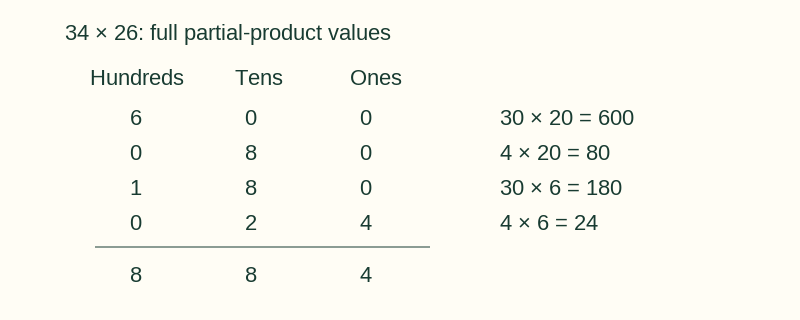
A partial-products ledger
| Pair | Value | Place-value reading |
|---|---|---|
| 30 × 20 | 600 | 6 hundreds |
| 4 × 20 | 80 | 8 tens |
| 30 × 6 | 180 | 1 hundred and 8 tens |
| 4 × 6 | 24 | 2 tens and 4 ones |
| Total | 884 | 8 hundreds, 8 tens, 4 ones |
Try the method
- Expand both factors into place-value parts.
- Calculate every pair, keeping the full values.
- Align ones, tens and hundreds before adding.
- Check the total against a rough product estimate.
Build and combine partial products
Expand both factors into their actual values
Thirty-four is thirty plus four, and twenty-six is twenty plus six. The digit three represents three tens, not three ones. The digit two represents two tens. Writing 34 = 30 + 4 and 26 = 20 + 6 makes those values explicit before any multiplication takes place.
Now combine each part of the first factor with each part of the second. Thirty meets twenty and six; four also meets twenty and six. There are four pairings altogether. A small two-by-two grid can help organise them, but the partial products can also be recorded as a labelled list.
Multiplying only thirty by twenty and four by six would omit two pairings. It would produce six hundred plus twenty-four, or six hundred and twenty-four. The missing eighty and one hundred and eighty total two hundred and sixty, accounting exactly for the difference from the correct result.
Calculate each partial product with place value
Start with 30 × 20. Three tens multiplied by two tens produce six hundreds, so the product is six hundred. You can also think of thirty multiplied by two to make sixty, then multiplied by ten to make six hundred. Both explanations preserve the value of twenty as two tens.
Next, 4 × 20 = 80 because four groups of two tens make eight tens. Then 30 × 6 = 180 because six groups of three tens make eighteen tens. Finally, 4 × 6 = 24. The smaller ones product may still exceed nine; it is a complete number with its own tens and ones.
Write the products as six hundred, eighty, one hundred and eighty, and twenty-four if the digits alone become confusing. Saying the full values can reveal a missing zero before addition begins. Each row should represent an amount, not a string of digits waiting to be positioned by a memorised rule.
Align values when adding the partial products
Leading empty spaces and internal zeros have different jobs. A blank hundreds position before eighty is harmless if the tens and ones stay aligned. The zero inside six hundred is part of its written place-value record. Omitting both zeros and writing six changes the value, even if the writer intended to remember the hundreds mentally.
Place six hundred in the hundreds column, with zero tens and zero ones. Place eighty in the tens and ones columns, leaving the hundreds position empty or using a zero placeholder. Place one hundred and eighty in hundreds, tens and ones. Place twenty-four with two tens and four ones.
Add the ones: zero plus zero plus zero plus four is four. Add the tens: zero plus eight plus eight plus two is eighteen tens. Eighteen tens equals one hundred and eight tens, so write eight in the tens position and include one additional hundred. The original hundreds are six plus one, making seven; with the additional hundred, the result is eight hundred and eighty-four.
You can instead combine convenient pairs mentally: 600 + 180 = 780, while 80 + 24 = 104. Then 780 + 104 = 884. This route may be easier to explain than one tall column, and it provides a second check on the addition stage.
Diagnose the missing-place-value mistake
Suppose someone writes the partial products for 34 × 26 as 60, 8, 18 and 24. The last product is correct, but the other three have lost factors of ten. The first should be six hundred, because it multiplies tens by tens. The second and third should be eighty and one hundred and eighty, because each multiplies one tens quantity.
Do not repair this by guessing where to append zeros to the final answer. The errors occur in different rows and have different sizes. Return to the expanded factors and explain each product separately. Once the rows are correct, add them again from their full values.
An estimate helps expose the issue. Thirty-four times twenty-six must exceed thirty times twenty, which is six hundred. A proposed answer of one hundred and ten is therefore impossible. This bound does not locate every mistake, but it shows immediately that the result needs checking.
Work through forty-seven times thirty-two
Expand forty-seven as forty plus seven, and thirty-two as thirty plus two. The four products are 40 × 30 = 1,200, 7 × 30 = 210, 40 × 2 = 80 and 7 × 2 = 14. All four values are needed, including the smaller fourteen.
Combine the first two as one thousand four hundred and ten; this is forty-seven times thirty. Combine the remaining two as ninety-four; this is forty-seven times two. Adding 1,410 + 94 gives 1,504. The zero in the tens position of the result arises from regrouping, not from an unused part of the calculation.
Check through doubling: forty-seven times thirty-two is the same as ninety-four times sixteen, then one hundred and eighty-eight times eight, then three hundred and seventy-six times four, then seven hundred and fifty-two times two. The final double is one thousand five hundred and four. This is a different exact route, useful if repeated doubling is secure.
Handle zero parts explicitly
For 50 × 24, expand twenty-four into twenty and four. Fifty has no nonzero ones part, so only two nonzero partial products are needed: 50 × 20 = 1,000 and 50 × 4 = 200. Their sum is one thousand two hundred.
A four-cell organiser could include a zero ones column, producing two additional zero products. Those zeros do not change the total. It is also correct to omit that zero column after explaining why it contributes nothing. The aim is to preserve values, not to insist that every multiplication must fill four positive cells.
For 103 × 12, standard expansion gives one hundred, zero tens and three. The nonzero products are one thousand, thirty, two hundred and six, which total one thousand two hundred and thirty-six. Keeping a visible tens column in the written addition can help avoid treating one hundred and three as thirteen.
Connect partial products to the standard algorithm
The standard written algorithm combines some partial products within each row. In 34 × 26, multiplying thirty-four by six gives two hundred and four: one hundred and eighty plus twenty-four. Multiplying thirty-four by twenty gives six hundred and eighty: six hundred plus eighty. Adding 204 + 680 gives 884.
The second row represents multiplication by twenty, so its ones value is zero. This explains the position often described as shifting a row left. The shift records a tenfold larger place value; it is not an arbitrary layout rule. Writing the row as six hundred and eighty before abbreviating the process makes that relationship clear.
Use the longer partial-products form whenever the compact layout becomes hard to explain. The two methods are connected records of the same distributive calculation. Speed is not the only reason to select a representation: a fuller record is useful when identifying a missing product or a place-value error.
Use the printable to check the whole process
The first question, 24 × 13, gives partial products two hundred, forty, sixty and twelve, summing to three hundred and twelve. Record labels beside the values so it is clear which comes from multiplying by ten and which comes from multiplying by three.
For 32 × 21, the parts are six hundred, forty, thirty and two, giving six hundred and seventy-two. For 46 × 15, they are four hundred, sixty, two hundred and thirty, giving six hundred and ninety. A final zero is a valid result of addition and does not mean the ones multiplication was omitted.
The later questions revisit 34 × 26 and include 47 × 32, a zero-part case and an internal-zero case. The incorrect-working item asks you to repair 30 × 20 = 60. Explain it as three tens times two tens, or thirty times two then times ten. A correction supported by a unit explanation is more useful than replacing the answer alone.
For a final check, cover the answer page and explain one product from expansion through addition. Ask another person to follow the labels. If they cannot tell where a row came from, add its factor pair. A well-labelled calculation should be readable after the person who wrote it has stepped away.
Choose further practice that matches the difficulty
A useful reverse question gives the four partial products and asks for the original factors. Suppose the values are six hundred, forty, thirty and two, with one factor split into thirty and two. Six hundred and forty both come from multiplication by twenty; thirty and two come from multiplication by one. The other factor is therefore twenty-one. Reconstructing the calculation as thirty-two times twenty-one checks that the products retain their factor relationships instead of becoming unrelated numbers to add.
You can also use an error comparison. If a learner gives six hundred and thirty-two for that product, ask which partial area is absent. The difference from six hundred and seventy-two is forty, corresponding to two times twenty. If they give sixty-seven point two, the issue is a tenfold scale change. These errors require different explanations. Keep the original expanded factors visible during correction, and identify the missing or misvalued quantity before doing further practice. Correcting the specific relationship provides a clearer next step than simply asking for the same calculation again.
Use small two-digit factors while the four pairings are new. Increase the arithmetic difficulty only after every pairing is consistently included. If the products are correct but addition is unreliable, practise combining those specific values rather than assuming that the multiplication model itself has failed.
The multiplication worksheet generator supplies further numerical questions. Draw a partial-products organiser beside selected items or use the printable provided here. The organiser and its place-value explanation are the teaching resource; the generator does not need to promise a specialised partial-products mode.
The rows combine more compactly in Standard algorithm multiplication with every step explained, while the place values remain the same.