 Rob

Equal-groups multiplication counts several groups when every group contains the same amount. Four plates holding three crackers each contain twelve crackers altogether: 4 × 3 = 12. The four tells us how many plates there are, the three tells us how many crackers are on each plate, and the twelve counts crackers across all the plates.
To compare separate groups with a more ordered arrangement, try the multiplication arrays guide. Keep the same total of objects and rearrange them into equal rows so you can discuss what changed and what stayed the same.
Open the printable equal-groups pictures, questions and answer page. Use counters, buttons or pencil marks to complete the activity. The groups are drawn as separate containers so that group count and group size remain visible throughout the work.
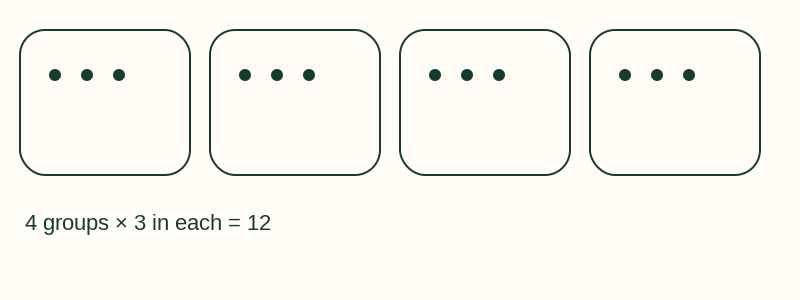
Keep the three quantities visible
| Groups | In each | Total |
|---|---|---|
| 4 | 3 | 12 |
| 5 | 2 | 10 |
| 3 | 4 | 12 |
Try the method
- Make the stated number of groups.
- Give every group the same amount.
- Record group count, group size and total separately.
- If a group differs, describe the unequal amount before choosing an equation.
From groups to equations
Keep three quantities separate
A multiplication situation has a number of groups, an amount in each group and a total. Before calculating, describe those quantities in words. For five envelopes containing two stickers each, we know the envelope count and the stickers per envelope; the total number of stickers is unknown. This is a multiplication question because we are combining equal known amounts.
Write “5 envelopes × 2 stickers per envelope = 10 stickers” as an explanation of the units. The numerical equation is 5 × 2 = 10. You do not add five envelopes to two stickers: they are different kinds of quantity. Grouping language prevents the common response 5 + 2 = 7, which combines the numbers without representing the situation.
Ask the learner to point to each quantity in a picture. They should point around all five envelopes when naming the group count, inside a single envelope when naming the group size, and across every sticker when naming the total. Correct pointing can reveal understanding even when the written equation is not yet fluent.
Build groups before drawing them
Place three small mats on a table. Put four counters on each mat, one mat at a time. Check that the first, second and third mats all have four. Say “three groups of four” and count the combined total as four, eight, twelve. The counting stops after three equal groups have been included.
Now move one counter from the first mat to the last. The total remains twelve, but the group sizes are now three, four and five. This arrangement is not three equal groups of four. That small change is worth discussing: multiplication describes the equal structure of the original arrangement, not merely the fact that twelve counters happen to be present.
Return the counter and draw three loops containing four marks each. A drawing need not resemble plates or bags realistically. Its purpose is to make the grouping unmistakable. Keep the loops apart, avoid marks touching their boundaries, and leave enough space to count within one loop without accidentally including a neighbouring group.
Connect each group to one addend
For three groups of four, write 4 + 4 + 4 = 12. Trace from the first group to the first four, from the second group to the second four, and from the third group to the third four. There are three addends because there are three groups. The repeated number is four because every group contains four.
The multiplication equation 3 × 4 = 12 compresses that repeated addition. In this article the first factor names the group count. Other explanations may read factor order differently; the crucial test is whether the learner can match the numbers to a clear model. State the convention before judging a picture-equation match.
Repeated addition is helpful for these whole-number examples, but the multiplication sign does not simply mean “add the two numbers”. Three plus four counts one three and one four. Three times four counts three copies of four. Laying the two models beside one another makes the difference visible without relying on a memorised instruction.
Compare equal totals with different groupings
Four bowls with three counters in each and three bowls with four counters in each both contain twelve counters. Draw both arrangements. In the first picture there are four containers; in the second there are three. Their totals agree because 4 × 3 = 3 × 4, but their descriptions do not mean the same arrangement.
This matters in word problems. If each craft kit must contain four buttons, twelve buttons fill three complete kits. An answer of four kits would require putting only three buttons in each kit. Knowing that the factors can exchange places in multiplication does not mean the labels in a real situation can be ignored.
A useful follow-up asks the learner to create two stories for the same pair of factors. “Six trays with two plants each” and “two trays with six plants each” both give twelve plants. Ask what changes, what stays the same and which number counts trays in each story. This separates the arithmetic property from the meaning of the quantities.
Recognise when equal groups do not fit
Imagine four shelves holding five, five, five and two books. There are seventeen books altogether. The expression 4 × 5 would count twenty books, including three books that are not actually there. You could calculate 3 × 5 + 2 because three shelves are full equal groups and one shelf has an extra amount.
Do not silently fill the short shelf when reading the original problem. If the task asks how many books are needed to make all shelves hold five, then the missing three becomes the answer. If it asks how many books are present, seventeen is the answer. The same picture can support different questions, so read the requested quantity carefully.
Equal means equal in the quantity being counted. Two boxes may be different colours or sizes and still each contain six pencils. Those boxes form equal groups of pencils for multiplication. Conversely, two identical-looking boxes do not guarantee equal contents. Count or read the stated amount rather than assuming equality from appearance.
Understand groups of one and empty groups
Five bags containing one marble each hold five marbles. The equation 5 × 1 = 5 follows directly from the model. One bag containing five marbles also has a total of five, expressed as 1 × 5 = 5. These examples keep the distinction between group count and group size even though the product looks unchanged.
Three empty bags contain zero marbles: 3 × 0 = 0. The bags are visible, but no marbles are inside them. A learner who answers three may be counting containers instead of contents. Ask for the unit of the answer and compare three empty bags with three bags holding one marble each.
Zero groups of four also gives a total of zero, although there are no actual groups to draw. A labelled empty workspace can represent the absence of groups. Start with positive examples if that abstraction is distracting, then use zero to check that the learner is following the quantities rather than automatically adding the factors.
Work through the printable pictures
The opening questions use complete groups and ask for three labels: groups, amount in each and total. Complete these labels before the equation. In the drawing section, sketch the empty containers first and then put the same number of marks in each. This order reduces the chance of drawing the right total with the wrong grouping.
The later questions ask whether a picture shows equal groups. A useful answer names the unequal amounts rather than saying only “no”. For example, “The groups contain three, three and two, so they are not three groups of three” explains exactly why multiplication by a single group size does not describe the entire arrangement.
One problem gives twenty counters arranged in five equal groups. Dividing the counters among the groups gives four in each, so 5 × 4 = 20. Check by recombining the five groups. This missing-factor question introduces the inverse relationship with division while preserving the same concrete group model.
Choose a useful next activity
Before moving on, ask the learner to invent a picture that would match 4 × 2 under the stated convention. Four separate pairs shows the intended structure. Then ask them to alter the picture so it no longer contains equal groups while preserving the total of eight. Their explanation of that change gives a more demanding check than naming the product again.
Move to arrays when separate groups are clear: line up each group as one row so that equal columns appear too. Alternatively, use a number line to show one equal jump per group. Both representations should preserve the group size and total rather than becoming unrelated pictures to memorise.
The multiplication worksheet generator supplies numerical practice. Add hand-drawn groups beside a few selected questions, keeping the factors small enough for the drawing to remain readable. A concise explanation of one model is more informative than a page of totals with no evidence of how the groups were understood.
Recording one addend per group is the next step in Repeated addition: from equal groups to multiplication.