 Rob

A useful multiplication strategy should explain the quantities in a problem and make the calculation manageable. Equal groups show what is being counted, repeated addition records the groups, arrays reveal rows and columns, and area models organise larger products. Partitioning connects unfamiliar products to facts you already know. These approaches describe the same arithmetic from different viewpoints.
Open the printable multiplication strategy diagnostic and worked answers. The short set asks you to model, calculate and explain a choice of method. It is designed to reveal which part needs attention: understanding equal groups, knowing small facts, preserving place value or combining partial products.
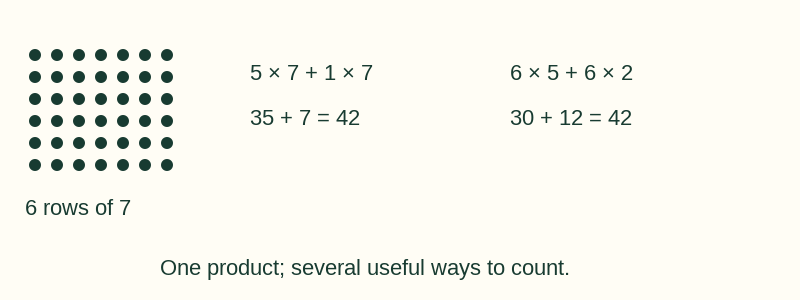
Choose a multiplication model
| Model | Read 6 × 7 as | Result |
|---|---|---|
| Equal groups | Six groups of seven | 42 |
| Known fact | 5 × 7 + 1 × 7 | 35 + 7 = 42 |
| Partitioning | 6 × 5 + 6 × 2 | 30 + 12 = 42 |
Try the method
- Name what each factor counts.
- Choose a model that preserves all six groups of seven.
- Calculate each part and recombine it.
- Check through a different model, not by repeating the same slip.
Choose a model for the question in front of you
Start by identifying what the two factors mean. In six trays containing seven seedlings each, six counts trays and seven counts seedlings per tray. The unknown is the total number of seedlings. A picture of six separate groups makes those meanings visible before any multiplication fact is recalled.
Then consider the size of the calculation. Drawing forty-two small objects may be useful once, but drawing six hundred and thirty-eight individual objects is usually a cumbersome way to organise a larger product. A labelled rectangle can preserve the multiplicative structure without requiring every object to be drawn.
Finally consider what is already known. A learner who knows five times seven can find six times seven by adding another seven. Someone who knows six times five and six times two can combine those products. The best available route depends on usable knowledge, not only on the numbers printed in the question.
Keep the purpose of the task in mind. If the question asks for an explanation of equal groups, a memorised answer alone is incomplete. If it asks for efficient numerical calculation, a fully detailed counter drawing may be unnecessary. A method can be correct while providing too little or too much detail for the particular purpose.
Pictures and partitions for the same product
Begin with equal groups
For 6 × 7, draw six containers and put seven marks in each. State the convention: the first factor is the number of groups and the second is the amount in each. Count the total as seven, fourteen, twenty-one, twenty-eight, thirty-five, forty-two. Each step includes one more complete group.
The equal structure matters. If one tray holds only four seedlings while the other five hold seven, the collection is no longer six groups of seven. Its actual total is five times seven plus four, or thirty-nine. Multiplication still helps count the five equal full groups, but the remaining amount must be handled separately.
This model is particularly useful for interpreting word problems and diagnosing whether someone is adding the factors instead of multiplying. Six plus seven gives thirteen, representing one six and one seven. It does not count six copies of seven. Pointing to the contents of every container makes the missing groups apparent.
Keep the answer unit attached. The product counts seedlings, not trays. A correct number with an incorrect unit can conceal a misunderstanding of the question. Ask the learner to say, “There are forty-two seedlings altogether,” and then explain where the six and seven appear in the drawing.
Record the groups as repeated addition
The same six trays can be recorded as 7 + 7 + 7 + 7 + 7 + 7 = 42. Each addend corresponds to one tray. There are six sevens and five plus signs; the signs connect the quantities and are not themselves groups.
Repeated addition is a useful bridge from combining known amounts to multiplication. Pairing the sevens gives fourteen plus fourteen plus fourteen, which also equals forty-two. Grouping the first five sevens gives thirty-five, followed by one more seven. Different addition routes preserve the same six copies.
The limitation is length. For twenty-three groups of fourteen, writing twenty-three fourteens is possible but leaves many opportunities to omit or duplicate an addend. Once equal groups are understood, a more compact model can retain the meaning and reduce the recording burden.
Do not describe multiplication universally as repeated addition without noting this whole-number setting. The model here concerns a whole number of equal copies. Later work with fractional or negative factors requires broader interpretations. For the present examples, repeated addition is a concrete explanation with a clear scope.
Arrange the same objects as an array
Put the six groups into six rows of seven. The array contains forty-two objects. Reading across gives six rows of seven, while reading down gives seven columns of six. That explains why 6 × 7 and 7 × 6 have the same product: both count the identical collection once.
An array is useful when the learner needs to connect two factor orders or see a product as parts. Draw a horizontal line after five rows. The upper section contains five times seven, or thirty-five, and the remaining row contains seven. The whole array therefore contains thirty-five plus seven, or forty-two.
A vertical split after five columns gives a different route. Each of the six rows contains five dots on the left and two on the right. The partial totals are six times five, or thirty, and six times two, or twelve. Adding thirty and twelve again gives forty-two.
The drawing must have equal rows and aligned columns. A scattered set of forty-two dots shows a total but hides the structure that makes multiplication useful. If drawing alignment becomes the main obstacle, use squared paper or a labelled rectangle after checking the equal-group meaning with counters.
Partition a factor into helpful parts
Partitioning records the array split numerically. For 6 × 7, use 6 × (5 + 2) = 6 × 5 + 6 × 2 = 30 + 12 = 42. The six multiplies both parts because every row contains both five and two. Multiplying only the five would leave most of the right-hand section uncounted.
The split does not have to be the same every time. Seven can be six plus one, giving thirty-six plus six. Six can be three plus three, giving twenty-one plus twenty-one. Choose a partition whose smaller facts are secure and whose final addition is manageable.
For 8 × 19, a nearby round number is helpful. Nineteen is twenty minus one, so eight times nineteen is eight times twenty minus eight times one. That is one hundred and sixty minus eight, or one hundred and fifty-two. The adjustment removes one from each of eight groups, so it removes eight altogether.
A common compensation error is to subtract only one after multiplying by twenty. The picture explains why this fails: the extra width-one strip runs through all eight rows. Draw that strip if the adjustment feels like a rule to memorise rather than a quantity to account for.
Use an area model for larger products
Consider 23 × 14. Represent the factors as the width and height of a rectangle. Split twenty-three into twenty and three, and fourteen into ten and four. The four resulting areas are two hundred, thirty, eighty and twelve, totalling three hundred and twenty-two.
This extends the same partitioning used with six times seven. The larger model simply splits both dimensions instead of one. Every part of the first factor must multiply every part of the second. A two-by-two grid makes the four required pairings visible.
The model supports place value. Twenty times ten is two hundred, not twenty or two. Four times twenty is eighty, while four times three is twelve. The side labels should display full values or clearly stated units such as tens; isolated digits without place-value meaning can lead to incorrect partial products.
Combine the areas in an organised way. The top row gives two hundred and thirty and the lower row gives ninety-two. Add 230 + 92 = 322. Alternatively, combine the left column as two hundred and eighty and the right as forty-two. Both routes cover the entire rectangle and must agree.
Move from pictures to partial products
Once the area model is understood, write its values as a list: 200, 30, 80 and 12. Their sum remains 322. This partial-products method keeps each piece explicit while removing the need to draw a rectangle every time.
The standard written multiplication algorithm compresses these steps further. For twenty-three times fourteen, one row represents twenty-three times four, or ninety-two, and another represents twenty-three times ten, or two hundred and thirty. Adding the rows gives three hundred and twenty-two.
A learner who loses the tens value in the compact algorithm can return to the expanded list or rectangle. The more detailed method is a way to inspect the arithmetic. There is no need to treat returning to a model as starting the whole topic again.
Check multiplication and addition separately. If all partial products are correct but their total is wrong, focus on combining the amounts. If one partial product is too small by a factor of ten, revisit its factor values. Naming the exact location of an error leads to more useful practice than repeating an entire page indiscriminately.
Use doubling, halving and known pairs carefully
Doubling one factor and halving an even other factor preserves the product. For 4 × 18, double four to eight and halve eighteen to nine, producing 8 × 9 = 72. Think of splitting each of four groups into two equal smaller groups: there are twice as many groups with half as much in each.
For 25 × 16, halving sixteen to eight and doubling twenty-five to fifty gives 50 × 8. Repeat to get 100 × 4 = 400. This can be convenient because the transformed factors make a familiar multiplication by one hundred. The changes must balance: doubling both factors would multiply the product by four.
With three factors, regrouping may reveal a helpful pair. In 7 × 4 × 25, combine four and twenty-five to make one hundred, then multiply by seven to get seven hundred. Brackets record the choice: 7 × (4 × 25). The factors retain their order while their grouping changes.
These are calculation strategies, so still return to the original quantities when writing a word-problem answer. Transforming four groups of eighteen into eight groups of nine can calculate the total, but it does not change how many actual boxes or trays the story says are present.
Use the diagnostic to choose the next step
The first task asks for a model of four groups of six. A learner should show four containers or rows, six objects in each and twenty-four altogether. If they write ten, compare one four plus one six with four copies of six. The next step is equal-group meaning, not a longer multiplication algorithm.
The second task asks for two routes to six times seven. Accept five sevens plus one seven, six fives plus six twos, or another valid partition with correct arithmetic. If the model is sound but a small fact is wrong, practise that fact with its array rather than rejecting the entire strategy.
The third task uses twenty-three times fourteen and asks for all four partial products. Missing thirty and eighty indicates incomplete distribution. Writing twenty instead of two hundred indicates a place-value problem. Correct cells with an incorrect final sum point to the addition stage.
The remaining questions include compensation for eight times nineteen, doubling and halving for twenty-five times sixteen, and a short story with unequal groups. The last task deliberately resists a single unadjusted product: three boxes of eight plus five loose items total twenty-nine. It checks whether the model follows the quantities rather than forcing every problem into identical groups.
Check a product through a different route
Estimate the size first, then use an exact alternative when needed. For 23 × 14, twenty-three times ten is two hundred and thirty, so the answer must be larger than that. Twenty-three times twenty is four hundred and sixty, so the answer must be smaller than that. Three hundred and twenty-two falls within those bounds.
For an exact check, calculate twenty-three times seven to get one hundred and sixty-one, then double it because fourteen is twice seven. The result is three hundred and twenty-two. This uses a different decomposition from the four-cell area model and can expose a missing region or incorrect sum.
Keep checks proportionate. A secure small fact does not require a long alternative calculation every time. Use a second representation when the answer conflicts with an estimate, when a method is new or when you need to locate an error. A check should produce evidence, not merely repeat the same uncertain steps.
Build a short practice sequence
When someone cannot explain their chosen method, reduce the size of the example while retaining its structure. Replace twenty-three times fourteen with three times four to check the meaning of a product, or use twelve times thirteen to check a four-cell partition with easier facts. Then return to the original numbers. Changing the arithmetic load in this controlled way helps distinguish uncertainty about the representation from uncertainty about individual multiplication facts. Record which explanation became clearer so the next practice question addresses the actual difficulty.
Choose one problem to model fully, one related problem to solve with a shorter record, and one problem that requires selecting a method. For example, draw six times seven, calculate six times eight from it, then decide how to handle six times nineteen. The progression connects meaning, a nearby fact and a different useful partition.
Ask for one sentence about each choice: “I used five groups and one more,” or “I multiplied by twenty and removed six.” These explanations reveal which quantities the learner is tracking. They also make it easier to distinguish a sound method with a small arithmetic slip from a method that does not represent the problem.
For further numerical questions, use the multiplication worksheet generator. Add the selected model beside a few questions, using the diagnostic printable for ready-made method comparisons. Keep the full range of strategies available, then choose the amount of detail that makes each calculation clear and dependable.
To make the rows and columns explicit, use Multiplication arrays explained with printable practice before shortening the calculation.