 Rob
Repeated addition adds equal amounts several times. The expression 6 + 6 + 6 + 6 contains four copies of six, so it can be written as 4 × 6. Both expressions equal twenty-four. Multiplication records the number of equal copies and the amount in each copy in a shorter form.
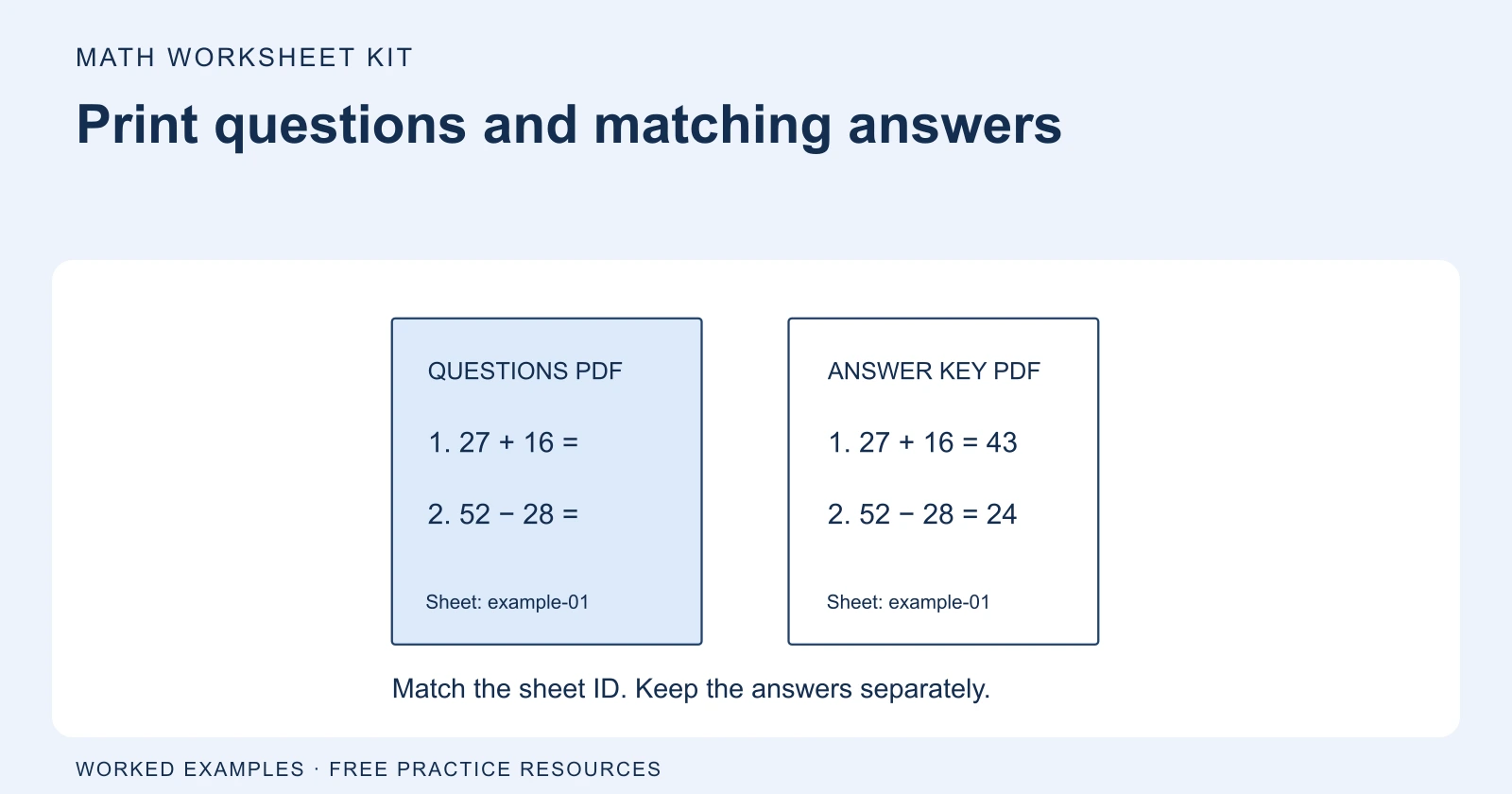
Open the printable picture-and-equation matching activity. It includes equal groups, unequal groups and expressions with similar numbers that represent different totals. The answer page explains each match; print it separately when you want independent practice.
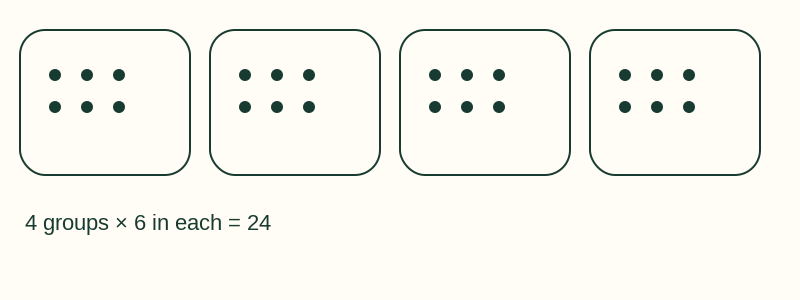
Match a picture to its expression
| Groups | Addition | Multiplication |
|---|---|---|
| Four groups of six | 6 + 6 + 6 + 6 | 4 × 6 = 24 |
| Three groups of four | 4 + 4 + 4 | 3 × 4 = 12 |
| Unequal groups of 3, 3, 2 | 3 + 3 + 2 | 2 × 3 + 2 = 8 |
Try the method
- Identify the amount repeated in each complete group.
- Count how many copies there are.
- Write one addend per group before writing the product.
- Keep any unequal or loose amount outside that product.
Reading equal and unequal groups
Read the repeated amount and its frequency
Look at 7 + 7 + 7. First identify the repeated amount: seven. Then count how many times it appears: three. Using “number of groups × amount in each group”, the multiplication expression is 3 × 7. Do not count the plus signs to find the number of groups. Three addends need only two plus signs between them.
That plus-sign mistake produces a useful diagnostic question. If someone writes 2 × 7 for 7 + 7 + 7, ask them to place one counter under each seven. There are three counters. The operation symbols connect the amounts; they are not the amounts themselves. The expression therefore describes three groups, not two.
Now reverse the task. To represent 5 × 4 as repeated addition, write five copies of four: 4 + 4 + 4 + 4 + 4. Count the copies before evaluating the sum. Writing four copies of five gives the same total, twenty, but it represents a different grouping under the convention used here.
Match an expression to a picture
Suppose a picture shows three baskets with eight apples in each. Cover two baskets and look at the remaining one. It contributes eight apples. Uncover each other basket in turn and record another eight. The full picture matches 8 + 8 + 8 and 3 × 8, both of which give twenty-four apples.
A picture of eight baskets containing three apples each also gives twenty-four apples. Its direct repeated addition is 3 + 3 + 3 + 3 + 3 + 3 + 3 + 3. Ask the learner to distinguish a matching total from a matching grouping. Both are useful mathematical observations, but they answer different questions.
On a worksheet, draw a connecting line from each basket to its corresponding addend. This gives every group a specific place in the expression. If an addend has no basket or a basket has no addend, something has been omitted or counted twice. The visual correspondence is a check before doing any arithmetic.
Calculate efficiently without losing the meaning
For 6 + 6 + 6 + 6, you can add successively: twelve, eighteen, twenty-four. You can also pair the addends: six plus six is twelve, and another six plus six is twelve, so twelve plus twelve is twenty-four. Both methods preserve all four sixes.
The multiplication fact 4 × 6 = 24 can eventually replace the longer addition. However, a learner should still be able to explain what the four and six mean. Knowing the answer is useful; knowing the structure makes it possible to reconstruct a forgotten fact and to decide whether multiplication fits a new situation.
Use known facts to shorten longer expressions. Seven copies of five can be split into five copies and two copies. That gives twenty-five plus ten, or thirty-five. The split concerns how many equal groups are being combined. It does not change five into seven or change the size of any individual group.
Know when one multiplication expression is insufficient
The sum 4 + 4 + 7 is not three copies of four and is not three copies of seven. It contains two equal fours and a different amount. A faithful shorter expression is 2 × 4 + 7, which equals fifteen. Replacing it with 3 × 4 would lose three from the original total.
Consider a delivery with three full boxes holding six books each and one loose book. The total is 6 + 6 + 6 + 1 = 19. Write 3 × 6 + 1 to preserve the full boxes and the loose item. Calling it four groups of six would invent five books that are not present.
There may be another way to rearrange a total into equal groups, but that is a new model. Fifteen counters from 4 + 4 + 7 can be reorganised into three groups of five. The equal total does not make the original groups equal. Make the rearrangement explicit when using it as an extension activity.
Connect repeated addition to equal jumps
Draw a number line starting at zero. For three copies of four, make jumps from zero to four, four to eight and eight to twelve. There are three jumps, each of length four. The endpoint twelve is the total. The starting point zero does not count as a completed jump.
If the line starts at two and makes the same three jumps, it finishes at fourteen. The complete expression is 2 + 3 × 4, not just 3 × 4. This distinction matters when skip-counting sequences begin somewhere other than zero. The equal step still matters, but the initial amount contributes to the endpoint.
Label the arcs with the amount added and number the jumps underneath if needed. That separates jump size from jump count. Counting tick marks can be misleading because a line with four labelled positions may show only three intervals between them. Follow the movement from one position to the next.
Include zero and one carefully
When writing an explanation, distinguish the expression from its value. The sum 2 + 2 + 2 and the single number six are equal in value, but the longer form shows three equal contributions. Keeping that structure visible is the reason to record repeated addition before shortening it to multiplication.
Four copies of zero give 0 + 0 + 0 + 0 = 0, matching 4 × 0 = 0. Four empty trays may be visible, but their contents still total zero. This is a useful check that the learner understands which quantity is being counted.
One copy of nine is simply nine; it does not need a plus sign. The equation 1 × 9 = 9 still describes one group containing nine. Zero copies of nine also gives zero, although the absence of addends is harder to picture. Use an empty collection of groups rather than writing a misleading expression containing one nine.
Review the activity through explanations
A useful extension is to ask for a missing repeated amount. If three equal groups total eighteen, each group must contain six, so the addition is 6 + 6 + 6. Check by sharing eighteen counters into three containers, then recombining them. Another question can give the amount six and total eighteen but leave the number of groups unknown. This time make groups of six and count how many complete groups appear. Both questions connect addition and multiplication, yet they hide different quantities. Label the unknown before selecting a calculation so the exercise remains about meaning rather than filling an arbitrary blank.
For 5 + 5 + 5 + 5, the direct matching picture contains four groups of five and the product is twenty. For two groups of seven, the addition is 7 + 7 and the product is fourteen. Ask the learner to name both the repeated amount and the number of repetitions before giving the total.
The deliberately unequal picture has groups of three, three and five. Its total is eleven, and 2 × 3 + 5 records its structure. An explanation that says “the last group is different” is a good start; naming the amounts makes the reason precise and distinguishes it from a counting slip.
Once picture matching is secure, use selected questions from the multiplication worksheet generator and ask for repeated-addition explanations. Keep drawings manageable. For larger whole-number products, partitioning or area models can express the same equal-group structure without writing dozens of repeated addends.
Use Equal groups multiplication with pictures and practice when the difficulty is identifying the repeated quantity rather than adding it.