 Rob

The standard multiplication algorithm is a compact way to record partial products. Its small carried digits represent exchanged place-value units, and its shifted rows represent multiplication by tens or hundreds. Understanding those meanings makes the method easier to check than memorising a sequence of movements across the page.
Open the printable standard-algorithm practice and explained answer page. The sheet starts with a single-digit multiplier, continues to two-digit multipliers and includes a three-digit example with an internal zero. Each answer identifies the partial rows so a misplaced digit can be traced to its value.
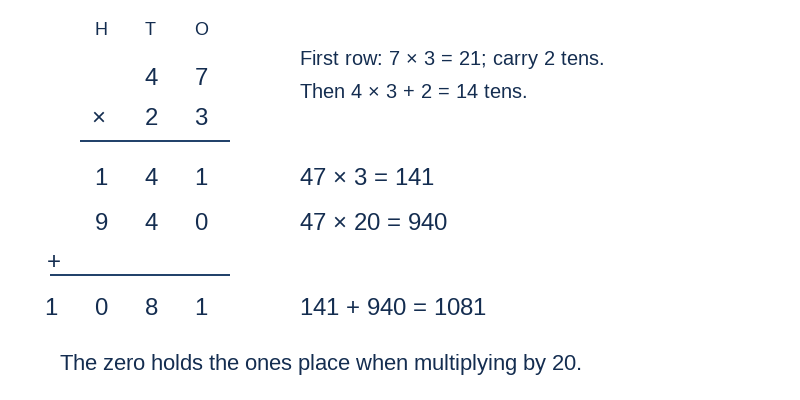
Follow the full multiplier value
| Row for 47 × 23 | Calculation | Written value |
|---|---|---|
| Ones multiplier | 47 × 3 | 141 |
| Tens multiplier | 47 × 20 | 940 |
| Add the rows | 141 + 940 | 1081 |
Try the method
- Align the numbers by their ones digits.
- Multiply by the ones digit and record each carry.
- Start the tens row at its correct place: it represents twenty, not two.
- Add the complete rows and compare with an estimate.
Build the two multiplier rows
Set up the columns before calculating
Write the factors one above the other with ones aligned beneath ones. For 47 × 23, place the seven above the three in the ones column and the four above the two in the tens column. Draw a horizontal line beneath the factors and leave space for two partial-product rows and their sum.
The factors do not need to have the same number of digits. In 236 × 4, the four belongs beneath the six because both occupy the ones position. Putting it beneath the two would suggest a hundreds multiplier in an ordinary aligned layout. Column labels can help until the placement is familiar.
Read the complete values aloud before starting: forty-seven and twenty-three, not merely four-seven and two-three. The digit two in twenty-three represents twenty. The algorithm may use the digit two during calculation, but the row produced by that digit must retain its tens value.
Start with one multiplier digit
For 47 × 3, first multiply the ones: three times seven is twenty-one. Twenty-one ones can be exchanged for two tens and one one. Write one in the answer’s ones column and record a small two above the tens column. That carried two means two tens, not two additional ones.
Now multiply three by the four tens in forty-seven. This makes twelve tens. Add the two tens carried from the ones product, giving fourteen tens. Fourteen tens equal one hundred and forty, so the complete result is one hundred and forty-one.
The order inside this step matters: multiply the original tens digit, then add the carried tens. Calculating three times the sum of four and two would multiply the carried amount again, producing eighteen tens instead of fourteen. The carry has already been created by the previous multiplication and only needs to be included once.
Check with expanded form: 3 × 40 = 120 and 3 × 7 = 21, so 120 + 21 = 141. The compact algorithm has combined the tens from these two partial products as it goes. The carried digit records that combination without writing two full rows.
Continue with the tens multiplier
Return to 47 × 23. The ones multiplier three produces the first partial row, 141. The next digit two represents twenty, so the second row must be 47 × 20. Calculate forty-seven times two to get ninety-four, then account for the factor ten: forty-seven times twenty is nine hundred and forty.
Write a zero in the ones position of this second row, or begin recording the product in the tens column with the place-value meaning clearly understood. Seven ones times two tens makes fourteen tens. Record four tens and carry one hundred. Four tens times two tens makes eight hundreds, and the carried hundred makes nine hundreds.
The row is therefore 940. Calling this “move the row one place left” describes the appearance, but “this row counts tens” explains the reason. The zero is a placeholder for zero ones in a whole-number multiple of ten. It is not an extra factor inserted after the multiplication.
Use fresh carry marks for the new row. The two tens carried while multiplying by three belonged to the first partial product and has already been included in 141. Reusing that mark while multiplying by twenty would count it twice. Cross out or clearly separate completed carries before starting another multiplier digit.
Add the complete partial rows
Now add 141 and 940 with ones, tens and hundreds aligned. The ones sum to one. Four tens plus four tens gives eight tens. One hundred plus nine hundreds gives ten hundreds, or one thousand. The final answer is 1,081.
The zero hundreds digit is needed because the result contains one thousand, zero hundreds, eight tens and one one. Writing 181 would lose the thousand’s position. A place-value chart makes this visible: the answer spans thousands through ones even though the original factors each had only two digits.
Estimate before accepting the answer. Forty-seven times twenty is nine hundred and forty, and forty-seven times thirty is one thousand four hundred and ten. Since twenty-three lies between twenty and thirty, the product should lie between those values. One thousand and eighty-one does; one hundred and eighty-one does not.
Work through a three-digit multiplicand
For 236 × 4, start with four times six ones, giving twenty-four ones. Write four ones and carry two tens. Next multiply four by three tens, giving twelve tens, and add the carried two tens to make fourteen tens. Write four tens and carry one hundred.
Finally multiply four by two hundreds, giving eight hundreds. Add the carried hundred to make nine hundreds. The answer is 944. Every step uses the original digit in its place, then includes the exchanged amount from the column immediately to its right.
Check using place-value parts: four times two hundred is eight hundred, four times thirty is one hundred and twenty, and four times six is twenty-four. Their sum is 800 + 120 + 24 = 944. This check keeps the partial products visible instead of repeating the same carry notation.
Notice that a carry may be larger than one. In whole-number multiplication by a single digit, the product of two digits can produce several tens. Treating every carry as “one extra” works for some addition examples but fails in multiplication. Read and record the actual exchanged amount.
Combine three digits with two multiplier rows
Consider 236 × 24. The first row, from multiplying by four, is 944 as above. The second row represents multiplication by twenty. Twice two hundred and thirty-six is four hundred and seventy-two, so twenty times that number is 4,720. Record its zero ones position explicitly.
Add 944 + 4,720. Four ones remain four. Four tens plus two tens gives six tens. Nine hundreds plus seven hundreds makes sixteen hundreds, so write six hundreds and carry one thousand. Four thousands plus that thousand gives five thousands. The result is 5,664.
A different exact check uses twenty-five minus one: 236 × 25 = 5,900, because a quarter of 23,600 is 5,900. Subtract one group of 236 to get 5,664. If this alternative involves unfamiliar reasoning, check with expanded partial products instead; a check should be understandable to the person using it.
Handle zero digits without skipping columns
In 304 × 6, six times four ones is twenty-four ones, so write four and carry two tens. Six times zero tens is zero tens, but the carried two tens still belongs in that column. Write two tens. Six times three hundreds is eighteen hundreds, giving the complete product 1,824.
The internal zero in three hundred and four does not erase the tens column from the working. It means the original number has no tens before multiplication. Exchanging twenty-four ones creates two tens during the calculation, which explains why the answer’s tens digit is not zero.
For 304 × 26, the ones row is 1,824 and the tens row is 6,080. The tens row comes from 304 × 20, not 304 × 2. Adding gives 7,904. Inspect the column addition to explain why the result has a zero tens digit even though both partial rows contain nonzero tens.
In the actual sum, four ones plus zero ones gives four. Two tens plus eight tens makes ten tens, so write zero tens and carry one hundred. Eight hundreds plus zero hundreds plus the carried hundred gives nine hundreds. One thousand plus six thousands gives seven thousands. Thus 7,904 has zero tens because ten tens were exchanged for a hundred.
Locate errors by the row they affect
A three-digit multiplier adds a hundreds row. For 402 × 305, the ones row is 402 × 5 = 2,010. The tens digit of the multiplier is zero, so its tens row contributes zero. The hundreds row is 402 × 300 = 120,600. Adding the nonzero rows gives 122,610. You may write the zero tens row explicitly or omit it after identifying its value, but the hundreds row must still begin at the hundreds place.
This example distinguishes an absent contribution from an absent place. Skipping the zero tens row does not make the three in three hundred and five become thirty. A learner who writes 12,060 for the last row has compressed the multiplier’s positions and effectively changed three hundred into thirty. Label the multiplier’s columns before starting if this confusion appears.
Check the result using a nearby whole number: 402 × 300 is already 120,600, so the full product must be a little larger. Five more groups add 2,010. The estimate and the exact adjustment agree on 122,610. This is a useful extension only after one- and two-row calculations are readable; adding more digits before the row values are understood merely makes the same misunderstanding harder to locate.
If 47 × 23 is recorded as 141 + 94 = 235, the first multiplication row is correct but the second has lost its tens value. Replace ninety-four with nine hundred and forty. The error is not in adding 141 and 94; it is in choosing the wrong quantity to add.
If the first row is 181, inspect the carry step. Three times four tens plus two carried tens should be fourteen tens, not eighteen. Multiplying the carried two by three again produces the incorrect eighteen. Explain where the carried tens originated before correcting the row.
If both partial rows are correct but their sum is wrong, check the addition independently. Draw a line between the multiplication work and the addition work so the two kinds of carry marks cannot be confused. A multiplication carry belongs to one partial row; an addition carry belongs to the final sum.
If a result is missing a zero in the middle, write the answer into a labelled place-value chart. Every occupied place must retain its position even when an intervening place has a value of zero. Reading the answer aloud can expose the difference between seven thousand nine hundred and four and seven hundred and ninety-four.
Use the printable in a deliberate order
Begin with 38 × 4. Four times eight gives thirty-two; write two ones and carry three tens. Four times three tens is twelve tens, and the additional three tens make fifteen tens. The complete product is 152. The carried three gives an immediate check that carrying is not always carrying one.
Next try 63 × 7, which gives 441, then 47 × 23 to introduce a second row. The two-digit question 58 × 32 has rows 116 and 1,740, totalling 1,856. Its first row includes regrouping, while its second row tests the value of the multiplier’s tens digit.
The three-digit questions include 236 × 4, 236 × 24 and 304 × 26. Use the expanded answers to check each row before comparing the final product. The error-analysis question gives 141 + 94 for 47 × 23 and asks for the specific place-value correction, not just a new answer.
Leave enough vertical space for separate carries and rows. Crowded working can make a completed carry look like part of the next calculation. If the paper is difficult to read, enlarge the layout or use squared paper rather than increasing the number of questions.
Keep a clear connection to meaning
The standard algorithm becomes compact because it combines partial products and exchanges units while calculating. A learner should be able to expand one carried step back into tens or hundreds when asked. If that explanation is uncertain, return to a partial-products grid for the same numbers and compare the two records.
Use the multiplication worksheet generator for more numerical products, selecting values that fit the written method you are practising. The printable attached here provides the original worked layout and sequence. Check one full explanation periodically so that accurate answers remain connected to place value.
If the zero in the tens row feels arbitrary, revisit Partial products multiplication without losing place value and name each full product.