 Rob

Skip counting means moving by the same amount each time. Starting at zero and counting in fours gives 0, 4, 8, 12, 16. Starting at three and using the same step gives 3, 7, 11, 15, 19. The starting number changes the sequence, while the repeated increase remains four.
Open the printable number lines and missing-number practice. The sheet mixes starting points, forward and backward sequences, and missing values in different positions. It includes a separate key with the step for each sequence so that the rule can be checked as well as the blanks.
Separate the start from the jumps
| Start | Step | Jumps | End |
|---|---|---|---|
| 3 | +4 | 4 | 19 |
| 28 | −6 | 4 | 4 |
| 4 | +5 | 3 | 19 |
Try the method
- Find the change between two known neighbouring terms.
- Apply the same signed step at every interval.
- Count jumps rather than written positions.
- Check the end using start + jumps × step.
Find the step before filling blanks
In the sequence 6, 9, 12, 15, consecutive values increase by three. Check more than one pair: nine minus six is three, twelve minus nine is three, and fifteen minus twelve is three. The repeated difference, rather than the final digit or the visual shape of the numbers, determines the step.
Then apply that step to a missing value. In 6, 9, blank, 15, adding three to nine gives twelve. Check from the other direction as well: fifteen minus three is twelve. Agreement from both neighbours is a useful independent check that you have placed the number correctly.
A short sequence can have many possible mathematical patterns. In this activity every question explicitly asks for a constant step, so equal differences are the intended rule. Do not claim that two displayed numbers uniquely determine every possible pattern. They determine the step only when the task states or establishes that constant-step structure.
Different starts and directions
Use intervals on a number line
Draw a line with positions labelled 0 through 20. To count in fives from zero, draw arcs from zero to five, five to ten, ten to fifteen and fifteen to twenty. Each arc crosses an interval of five units. The equal arc lengths correspond to the equal numerical differences.
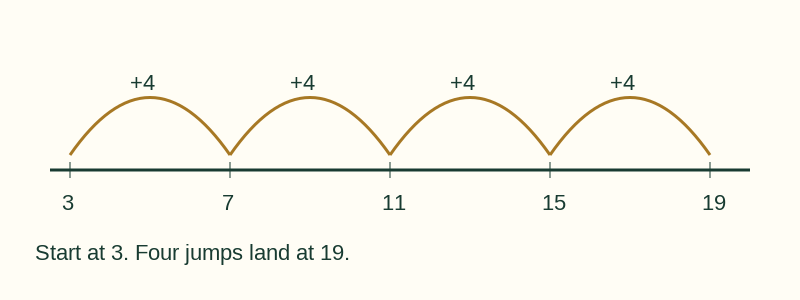
For counting in fours from three, mark three as the starting position and land at seven, eleven, fifteen and nineteen. The starting position is not a jump. If a question asks where four jumps finish, count four arcs and arrive at nineteen. Counting the first label as jump one would stop at fifteen instead.
Spacing should reflect value on a scaled number line. If zero, five and ten are equally spaced, fifteen belongs the same distance beyond ten. A list of numbers written in boxes is a sequence display, but it is not necessarily a scale drawing. Name the representation clearly so learners do not use arbitrary box spacing to infer numerical distances.
Explore starts that are not zero
Counting in sixes from zero gives 0, 6, 12, 18, 24. Counting in sixes from two gives 2, 8, 14, 20, 26. Both sequences have a step of six, but the second sequence does not list multiples of six. Each term is two more than the corresponding term in the first sequence.
This prevents a narrow association between skip counting and reciting a times table. A learner who knows multiples of six can use that knowledge, then add the starting offset. For example, after four jumps from two, the endpoint is 2 + 4 × 6 = 26. The two accounts for the value already present before jumping.
Try a context with a starting amount. A plant is eight centimetres tall in a simplified pattern and gains three centimetres per interval. The recorded heights are 8, 11, 14, 17. After three intervals the height is seventeen centimetres. This is an invented arithmetic pattern, not a claim that actual plants grow by a constant amount.
Count backward by a fixed amount
Backward skip counting subtracts the same amount repeatedly. Starting at thirty-one and subtracting five gives 31, 26, 21, 16, 11. The step can be described as “subtract five” or as a change of negative five. The values on this particular sheet remain nonnegative, so negative-number knowledge is not required.
A common error is to reverse digits or switch to the nearest familiar multiple. From thirty-one, subtracting five gives twenty-six, not thirty or twenty-five. Use five one-unit backward moves or decompose the subtraction as one to reach thirty and four more to reach twenty-six if crossing a ten causes difficulty.
Check a backward sequence by reading it in reverse. Eleven, sixteen, twenty-one, twenty-six, thirty-one increases by five. This does not change the original direction of the question, but it gives another way to verify the values. A learner may recognise an addition fact more readily than the matching subtraction.
Handle more than one missing position
Consider 4, blank, blank, 19 when the task specifies equal steps. There are three intervals between four and nineteen. The total increase is fifteen, so each step is fifteen divided by three, or five. The complete sequence is 4, 9, 14, 19. Dividing by four would confuse the number of positions with the number of intervals.
When enough consecutive values are shown, use their difference first. For 7, 11, blank, blank, 23, the first pair establishes a step of four. Continue to fifteen and nineteen, then check that the next step reaches twenty-three. This final agreement catches a misplaced blank or an accidental change of step.
If the first term is missing, work backward from a known term. Blank, 13, 18, 23 increases by five, so the missing first value is eight. The missing term does not have to be zero or the step itself. Looking at the position of the blank matters as much as knowing the counting pattern.
Use digit patterns as clues, then check the rule
Counting by tens keeps the ones digit unchanged: 7, 17, 27, 37. Counting by fives alternates between two possible ones digits: from two it gives 2, 7, 12, 17, 22. These are useful observations, but the full numbers still matter. Matching the final digit alone does not prove that a value belongs in a particular position.
For example, 3, 13, 33, 43 all end in three, but the differences are ten, twenty and ten. Twenty-three is missing if the intended step is ten. Ask the learner to inspect each gap rather than approving the sequence from its visible digit pattern.
When counting in twos, the parity stays the same: an even start stays even and an odd start stays odd. That offers a quick error check, not a complete solution. In 1, 3, 7, 9 all numbers are odd, but one gap is four. Six consecutive terms from one should be 1, 3, 5, 7, 9, 11.
Use the sheet to identify the difficult step
Begin with one forward sequence and one backward sequence. Ask the learner to write the rule in words, then fill the blanks. If the rule is correct but one calculation is wrong, focus on the addition or subtraction at that boundary. If the rule changes partway through, return to comparing consecutive differences.
For the number-line activity, have the learner mark the start before drawing jumps. Label every landing point and count the arcs aloud. For the multiple-blank activity, draw a small arc for each missing interval even if the number line is not to scale. The interval count helps organise the arithmetic without pretending to show exact distances.
The key gives 5, 9, 13, 17, 21 for a start of five with a step of four; it gives 28, 22, 16, 10, 4 for a start of twenty-eight with a decrease of six. Check each neighbouring difference, then check the overall change. Four increases of four add sixteen, and four decreases of six remove twenty-four.
Connect jump counts to multiplication
To vary the activity without making the arithmetic harder, change which information is supplied. Give the start and step and ask for the endpoint, or give consecutive terms and ask for the step. Later, give the start, endpoint and number of jumps. For example, going from six to twenty-two in four equal jumps means increasing by sixteen overall, so each jump is four. These tasks use the same values but require different reasoning. Keep the number of jumps explicit: without that information, several different constant steps could connect the two endpoints.
From zero, six jumps of three land at eighteen because 6 × 3 = 18. From four, those same jumps land at twenty-two because the initial four remains part of the total. Write “start + number of jumps × step” in words before using the numerical expression to keep the three quantities distinct.
This connection is useful when moving to the multiplication worksheet generator. Choose a few whole-number products to illustrate as equal jumps from zero. For nonzero starts, use the supplied printable: a plain multiplication question by itself does not include an initial offset.
Counting backwards by a fixed amount becomes a division model in Division as repeated subtraction on a number line.